THANK YOU TO WILDLIFE RESCUERS AND REHABBERS IN SOUTH CAROLINA

Photo Credit: Lora Anant

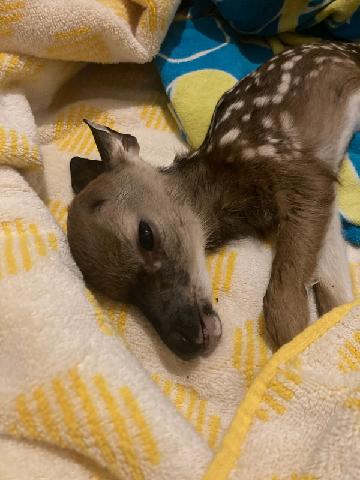
Calls have been pouring in since the beginning of May.  But the day after Memorial Day was perhaps the busiest day we’ve had so far.  That day a call came in from Steve Howell in South Carolina.  Steve had scooped up a tiny deer in the middle of a road on a dark night.  The fawn would have been killed if he hadn’t intervened.  He took the fawn home, tried to find help and discovered our hotline number. 

We gave him several numbers of deer rehabbers in his area, and at 10 pm,  Lora Avant arrived with her husband to bring the little deer back to their center.  You can see that it was difficult for Steve to let the baby go!

Steve was so impressed with Lora that he called Wildlife Watch back to thank us for the referral.

Of all of the animals that are found, fawns are the ones that evoke the most emotion in people.  First there’s  surprise or shock upon seeing the fawn, then there’s an overwhelming need to protect the fawn, along with a desire to nurse.  While we normally suggest that people put the fawns back where they found them, there are times when circumstances make it impossible.

We’re so happy that our hotline allows us to connect the compassionate public with nearby wildlife rehabilitators.

We later contacted Lora to see how the fawn was, and ask if we could let our readers know of a wildlife rehabilitation center in her area.

She recommended Wild Things in Georgetown, SC. Lora wrote: The little buck is doing great! He is drinking about 2.5 ounces at each 4-hour feeding and has made himself at home with the two other little buck fawns. They are jumping and playing and nibbling on the grass.

Please visit their FB page here: 

https://www.facebook.com/wildlifefreedom1

And their website:

https://wildthingsfc.org/?fbclid=IwAR3MgJTnB0XuMUcMlAhVsbjWXNPMudjz50o6bvroAxtsb3_O8sV8bIPALQ

Lora sent this photo with Steve’s little buck (front) who is playing with 2 other orphaned male fawns. (Photo Credit: Lora Anant)

R.O.C.K. – Rehabbers Offer Care and Kindness

The Wildlife Watch Hotline - 877-WILDHELP receives hundreds of calls every year from across the country, and a few from Canada.  Police departments, conservation agencies, SPCAs, veterinary offices, and federal, state, and municipal offices have referred callers to Wildlife Watch for help. 

Your contribution to Wildlife Watch will help us to expand our volunteer service by allowing us to cover phones 24/7 and update our lists as new wildlife rehabilitators come on the scene.

A Year in COVID: What Nature Taught Me

By Cynthia Hacker

It’s been one year since our world changed, and many of us are reflecting on the last 12 months. March 2020 brought a threat to our shores we had never experienced. For the first time, we faced our own mortality in a very real, very scary way. I had always found peace and healing in the outdoors, but this year many of these spaces became quite crowded. I needed to go “off-the beaten path.” It was here that I found a simple, life-affirming connection and comfort with my “other neighbors.” The nonhuman kind.

Kin and Ki

Biologist and author Robin Wall Kimmerer writes in her book, Braiding Sweetgrass, that we reserve pronouns of personhood, such as, “he,” “she,” and “they” for humans, leaving a nonhuman species to be an “it.” Wall Kimmerer wanted a word for all beings—plants, animals, landscapes, even elements like rain or snow. English already had the perfect word for plurals with kin, a word most are familiar with, but not for a single nonhuman being. Searching her native Potawatomi language for inspiration, Wall Kimmerer found the simple word “ki” to describe any living being. “So that when the robin warbles on a summer morning, we can say, ‘Ki is singing up the sun,’” or “Ki’s branches sway in the pine-scented breeze,’” she wrote.

 In these quieter places, each individual plant, bird, and insect—each ki—began to feel like an old friend, and every visit was a new chance to see all my new kin together and be invited into their homes.

Spring 2020

Red-winged Blackbird - photo credit: Kieren Wood (unsplash)

In spring, life was beginning in the outdoors, while inside, we heard the sad stories of human life waning. It comforted me to see and hear all the new life of Spring in a place called “Giant’s Ledges Pocket Park,” a parcel of land that spans the northern part of the Shawangunks, connecting the iconic Bonticou Crag to the hamlet of Rosendale. One early April evening, when ki’s (Spring’s) magic was already in full bloom, I took the gradually climbing, woodsy trail, carpeted in fragrant, soft pine needles, to an inviting rocky cliff, where one can perch and look out on the valley below. I sat on the summit listening to the sounds of kin around me. The first to hit my ears was the music of the peepers in the leafy green chasm below. It is one of my favorite sounds in nature. These kin tell you that life is renewing and warm weather is coming. It’s funny, as you sit and begin to listen to the sounds of nature around you, it is as if a veil suddenly lifts, and underneath, you discover even more layers of “music.” I then recognized another familiar voice—it was the song of the Red-winged Blackbird, a friend I knew well from grassy flatlands. Ki sings a very strong, beautiful melody, easily recognized by his sharp, chirpy notes. Ki’s bold red and black colors also make him easy to spot for my not-so-sharp eyes. 

Pretty soon, the forest was alive with song. Birds have been around a long time; they are resourceful and they know how to survive. They thrive because they persist. Here, kin were singing out with the spirit of life. At this same moment, in the world of the human, kin were singing out from the streets, from porches, from windows—it was the time of the 7pm “applause” for healthcare workers. It’s no secret how separated most of us have become from the natural world, but here, I could feel the two songs mixing together. Perhaps all kin cry out in the same vein. We are so much more connected than we realize. 

Summer 2020

Summer came and brought with it more lush green growth, more achingly beautiful days, and cerulean skies with what I like to call cartoon-perfect “Simpsons” clouds. Being outside was easy, and we enjoyed a little more socializing. This time, my attention was captured by kin of the six-legged variety. It began with the arrival of the dragonflies in the late spring. On New Paltz’s River to Ridge trail, hordes of them flew overhead, with gossamer wings and zigzag movements. I stood, my mouth agape, mesmerized as they danced overhead, their flight patterns reminding me of fancy airshows. They would zip through the air at full speed in one direction, then inexplicably and seamlessly U-turn toward the opposite way. I never knew they could fly so high or so fast, and I wondered what their movements communicated to each other.

At the Peterskill area of Minnewaska, I was treated to more dragonfly action, seeing them land on streams, leaves, and even my arms in the warm summer sun. Kin were sometimes neon blue, magenta, or even green—and they stared at me with their mysterious alien eyes. It feels like a gift when a dragonfly alights near you, or decides to buzz around you. You feel like you have been visited by someone special. Having evolved over 300 million years ago, they are one of the oldest creatures on earth, and these kin have captured our fancy for a long time. Folklore is filled with their stories.   What’s most astonishing is ki’s ability to transform. A dragonfly will molt and change an average of 17 times, with most of the changes occurring during the time they spend underwater before they even take flight. Ki’s amazing flight is the direct result of the ability to change. We, too, must learn to change with grace so that we may continue to evolve and thrive.

Summer continued to wow me with insect kin of all types—the fireflies at night reminding me there is still hope even in darkness; the monarchs, with their regal saffron-oranges and striking blacks, gracing me with their late-summer visit; and the occasional spotting of the praying mantis, reminding me that it is good to get very still and sit with your thoughts. Like summer, these beauties are only here for a short time. Next year, we will get to know their children. Until then, we make peace with saying goodbye to the warm embrace of summer nights and learn that life is, indeed, ephemeral.

A neon-blue dragonfly alights on a leaf in the Peterskill area of Minnewaska State Park, New Paltz

Fall 2020

Photo credit: Boris Smokrovic - Grasshopper’s face” (unsplash.com)

Hudson Valley Fall 2020 was another masterpiece, and predictably brought throngs of tourists to view it. I was schooled by others not to get too angry—I mean, can you blame them? Who wouldn’t want to see this marvel of color? And, truthfully, it’s just another reason to feel and express gratitude for being able to live here and see it every day. So I did.

I often headed over to the Shawangunk Grasslands in Wallkill. One would think miles of flatlands and grasses would be boring, but I soon learned that was not the case. Look deeper into the grass and you will see that it is not one, but a multitude of different plants, each ki with another shade of golden, blending together in glowing harmony, lit by the sun. Here amongst the grasses, I found some very cool residents. Chittering on the dry ground, boing-boing-ing around my knees, there was Grasshopper, a new teacher and friend. Almost looking like a piece of dried grass himself, he played among my feet, bouncing along, occasionally springing into a short flight around my face, and then landing again in the grass. I found ki to be a very whimsical creature, though I knew well enough not to think the behavior was for my entertainment. Grasshoppers, I learned, are even older than dinosaurs; these kin have very strong survival skills.

Curious about my new friend, I began to read. I learned that ki has the amazing ability to catapult, jumping the equivalent of a football field. Ki is also a music-maker, creating individual rhythms through stridulation, or rubbing their hind legs and wings together. Then I found something even more interesting in an article by NPR titled, “What an Insect Can Teach Us About Adapting to Stress.” Normally solitary creatures, grasshoppers only form swarms under stressful conditions. The process of stridulation not only produces pretty music for my ears, but also produces serotonin for the grasshoppers, allowing them to feel good, and thus, more sociable. When these kin cluster together, they can share resources and survive; this “new version” of themselves can literally save them. We, too, can no longer see ourselves in the same way. Like the grasshopper, we must accept and grow, to survive.

Winter 2021

In mid-winter, ice created castle-like formations on the Upper Awosting Trail of Minnewaska State Park, New Paltz. (Photo Credit: Cynthia Hacker)

Nature continued to bless me with so many gifts that this winter felt like one continuous Christmas. Early on, I got some of my old hikes back with a much less crowded Minnewaska. Now trained to really look at things, I delighted in noticing how in the first month of winter, the previous three seasons were also present. When I fixed my gaze upon the forest floor, I saw autumn leaves, their now tan skins mingling with the dark soil underneath. Remnants of the first snowfall dusted the leaves and remained in patches on logs, branches, and tree roots, its fresh white contrasting with pillows of bright green mosses. I could even see summer buds, though now blackened by winter, down in the brambles by the stream. Rocks with glints of reddish orange peaked out along the streambeds, adding even more color to the unique collage. The air had a freshness like no other time of the year—with the rushing water, dripping snowmelt, and carpets of moss and lichens, everything felt alive. It was a wonderful time to be in the forest.

For Christmas, I received the gift of meeting my first owl at the Grasslands. One day, I found the parking lot unusually crowded. People were everywhere with big, clunky camera set ups, and most trails were closed. I was quickly informed by the photographers to be quiet, as the Short-eared Owls were wintering here. Since they are large birds, I spotted one within seconds, but coincidentally, I had just been gifted a pair of binoculars from a local swap group. I eagerly took them out and saw my first owl face up, close and personal. Perched on one of the many posts in this popular birding sanctuary, ki was both majestic and strange, with a concave face that was at once beautiful and odd. I watched ki twitch that face back and forth, eyeing the land, until taking flight once again with a grand spread of his wings.

In January, no sooner had I commented on what a nice, balmy winter it had been than Winter decided to be, well, winter. A long stretch of snowfall kept the Hudson Valley wrapped in a powdery white blanket for much of February. A self-professed non-fan of snow, I groaned. Winter was a long season to begin with, I thought, and now with COVID-19 numbers on another very scary rise, I worried how I would ever get through. But soon enough, I was seduced by the beauty of the white stuff and I did something I’d never done before: I fell in love with winter. I couldn’t get enough of it--the way the snow glistens in the sun, the way snow will let the wind create works of art on its surface. Walking in the woods on a snowy day was like entering another world, a hidden treasure. In a way, winter is the most personal of all the seasons. The quiet is so close, it feels like a friend, a sort of ki of its own.

On what we knew would probably be the last big snowfall of 2021, my partner and I ventured into the woods as the flakes fell, and played in the Narnia-like magic that is winter. I purposely went off the trail, submerging myself in the glitter I knew wouldn’t be here that much longer. I even made a snow angel and lay on my back, studying the treetops. I couldn’t believe it. I would miss winter. Ki had taught me to allow more stillness, to get between the spaces of my thoughts. To be present, and experience a deeper knowing.

Short-eared owl (Photo credit: Vincent van Zalinge (unsplash.com)

One Year 2020-2021

How will we emerge from this experience? I would like to think I learned a little bit more about just how precious life really is—and that there are a lot of things I thought were important that really aren’t. My friends in nature, my kin, were my best teachers. Who were some of yours?

Please let us know the answer by sending your personal wildlife communion experience to Wildlife Watch at wildwatch@verizon.net – We would love to see it, and may publish it!  We also welcome your photos and their back stories.

Cynthia Hacker lives in New Paltz, NY.  She spends her free time exploring the many wild places that grace the area. She is a lover of nature and a nature writer. 

This article is also published in www.honeyguidemag.com

Demystifying Bats

By Bindu Gopal Rao

 *All Photos Courtesy of Avian and  Reptile Rehabilitation Center – ARRC

Even as the COVID-19 pandemic rages on, the rumor that the coronavirus in people was caused by bats is just a myth, like many other false accusations that cause the only flying mammal to be feared rather than appreciated.         

Bats are nocturnal mammals who are unfortunately very misunderstood. ‘Blind as a bat’ is probably the most abused phrase. Did you know that bats are not blind? Well if you did not, it’s time to take a reality check.  Bats do not fly into your hair or eyes nor get stuck to you. Bats have extremely good vision and can fly as close to your nose tip and go back without touching you.

Dr Bandana Aul Arora, a mammalogist and conservationist who has decades of work experience with the Nicobar flying fox and other threatened species in the ecosystem of the Nicobar group of islands, India, is dispelling many of these myths.  He says, “Bats like other mammals give birth to young ones or pups and are very protective mothers; fruit-eating bats carry their babies till they are independent. They are extremely handsome, have beautiful ears and very charismatic nose leaves.” Research is taking place now to understand how they locate their prey.  To find prey and their roosts, the method is called echolocation and is mostly seen in insect-eating bats. A bat can eat three times his or her weight each day, so they clearly have no appetite problem!

Rohit Chakravarty, a Ph.D. student at Leibniz Institute for Zoo and Wildlife Research, Berlin, Germany, explains, “Bats perform two main functions that benefit humans and the ecosystem. Fruit-eating and nectar-drinking bats are pollinators of many tropical trees. Three examples of such important trees in the Indian context are some species of mangroves, wild bananas and the mahua tree. This tree has important medicinal properties. 

Insect-eating bats eat tons of insects that are pests in rice, corn and cotton farms. These come from studies in the US and Thailand. New studies have also shown their importance in controlling pests in vineyards in France and Chile. Once they have had their fill in the night, they poop in heaps in caves which make for a useful natural fertilizer. Guano mining is an industry (sometimes sustainable, but often not) mainly in Southeast Asia.”

Bats are incidentally extremely gifted and don’t have hollow bones like birds. Bats are the only mammals that are capable of a true powered flight and fly with their hands, not their arms. They live in huge colonies and like to stay in slightly dark places like caves, beneath bridges, in trees and abandoned buildings because it is cooler.  Additional facts: They cannot tolerate extremes of weather.  They give birth once a year and do not pair for life. There are about 1000 species of bats worldwide, India has about 119 species.  The size range is large: the smallest one, the bamboo bat, is only as big as your thumb, while the flying fox, a fruit eater, has a wingspan of over 5 feet!

Insectivorous bats also actively prey on mosquitoes - a known disease-carrying vector that affects humans directly.

A recent study has shown that bats serve as indicators of potential invasive insect species in Spain. Baheerathan Murugavel, a Ph.D. student at the Indian Institute of Science Education and Research Thiruvananthapuram, India, said,  “To my knowledge, the best practice to manage invasive species in any landscape is to identify them before getting invaded and keep them controlled. Based on the diet of insectivorous bats, researchers in Spain have recently identified a rice pest weevil which is an insect native to North America, with the potential to become invasive in the future. The researchers point out that bats could act as potential natural samplers that could detect (and possibly control) pest species in important growing areas of cash crops, such as the rice paddy.”

Dr. Arora has worked extensively on the Pteropus faunulus or the Nicobar flying fox which is endemic to the Nicobar Islands and has been rediscovered after 100 years.

It is distributed only in six of the islands there. Unfortunately, this solitary roosting fruit bat is locally extinct from Car island, where it was first seen. As part of her research, she has found 22 species of bats in the Andaman and Nicobar Islands.  She said, “Bats do have direct threats as bats are poached for their meat that is used for medicines, as well as habitat loss. Indirect threats include frequent human entry into caves, and adverse myths that they are disease spreading and blood sucking creatures are other threats.”

And while bats are resistant to several viruses, the coronavirus is not really something that has come from bats. The Bat Conservation Trust in UK also confirms in this COVID-19 and Bats - Bats and disease - Bat Conservation Trust. “The exact wildlife to human transmission route for SARS-CoV-2 virus is not known as yet. There are two main schools of thought both with adequate support. A precursor of SARS-CoV-2 called RaTG13 (both shared a common ancestor probably 40-70 years ago) originated in a family of bats called ‘horseshoe bats’. RaTG13 by itself is not known to infect human lungs because it cannot bind to the lung epithelial cells. Some molecular studies have shown that this virus went into an intermediate host, most likely a pangolin, where it recombined to become SARS-CoV-2 which can infect human lung cells. This view was later challenged in another paper that showed evidence that the SARS-CoV-2, in fact, originated in horseshoe bats in China 40-70 years ago and has the potential to infect humans directly,” says Chakravarty.

Viruses of such zoonotic origins crossing the species-barrier and reaching humans is called a spillover event and it is not something that happens frequently or easily. “One should look closely to ponder what could trigger such spillover events in order to prevent such pandemics in the future. From COVID-19 it is almost certain that human induced events are likely to be reasons for this. Events like habitat destruction, over-exploitation of wildlife resources, unhygienic wet market systems (that make different wild animals interact) causes wild animals to get over stressed and puts them in close contact with humans.

 To summarize, “To prevent future pandemics, we need to focus on how humans caught these viruses (routes of transmission) instead of blaming the animal origins itself,” states Murugavel.

Bats are certainly misunderstood, it’s time for us to change our attitude towards this intelligent and vital mammal. 

Bindu Gopal Rao is a freelance writer and photographer based in Bengaluru.  She has a special interest in the environment.  She enjoys birdwatching and looking for local and unusual stories in any destination.  You can follow her on Instagram @bindugoplrao and view her work on www.bindugopalrao.com

Editor’s Note: This article was written prior to concerns that the novel coronavirus might have originated in a lab in Wuhan, China.  So far, its origin is unknown and the jury is still out over whether it was caused by a “spillover” event or a lab leak.

DEMYSTIFYING BATS

Bindu Gopal Rao 

All Photos Courtesy of Avian and Reptile Rehabilitation Center – ARRC

Even as the COVID-19 pandemic rages on, the rumor that the coronavirus in people was caused by bats is just a myth, like many other false accusations that cause the only flying mammal to be feared rather than appreciated.

Bats are nocturnal mammals who are unfortunately very misunderstood. ‘Blind as a bat’ is probably the most abused phrase. Did you know that bats are not blind? Well if you did not, it’s time to take a reality check.  Bats do not fly into your hair or eyes nor get stuck to you. Bats have extremely good vision and can fly as close to your nose tip and go back without touching you. 

Dr Bandana Aul Arora, a mammalogist and conservationist who has decades of work experience with the Nicobar flying fox and other threatened species in the ecosystem of the Nicobar group of islands, India, is dispelling many of these myths.  He says, “Bats like other mammals give birth to young ones or pups and are very protective mothers; fruit-eating bats carry their babies till they are independent. They are extremely handsome, have beautiful ears and very charismatic nose leaves.” Research is taking place now to understand how they locate their prey.  To find prey and their roosts, the method is called echolocation and is mostly seen in insect-eating bats. A bat can eat three times his or her weight each day, so they clearly have no appetite problem!

Rohit Chakravarty, a Ph.D. student at Leibniz Institute for Zoo and Wildlife Research, Berlin, Germany, explains, "Bats perform two main functions that benefit humans and the ecosystem. Fruit-eating and nectar-drinking bats are pollinators of many tropical trees. Three examples of such important trees in the Indian context are some species of mangroves, wild bananas and the mahua tree. This tree has important medicinal properties. 

 Insect-eating bats eat tons of insects that are pests in rice, corn and cotton farms. These come from studies in the US and Thailand. New studies have also shown their importance in controlling pests in vineyards in France and Chile. Once they have had their fill in the night, they poop in heaps in caves which make for a useful natural fertilizer. Guano mining is an industry (sometimes sustainable, but often not) mainly in Southeast Asia."

Bats are incidentally extremely gifted and don't have hollow bones like birds. Bats are the only mammals that are capable of a true powered flight and fly with their hands, not their arms. They live in huge colonies and like to stay in slightly dark places like caves, beneath bridges, in trees and abandoned buildings because it is cooler.  Additional facts: They cannot tolerate extremes of weather.  They give birth once a year and do not pair for life. There are about 1000 species of bats worldwide, India has about 119 species.  The size range is large: the smallest one, the bamboo bat, is only as big as your thumb, while the flying fox, a fruit eater, has a wingspan of over 5 feet!

Insectivorous bats also actively prey on mosquitoes - a known disease-carrying vector that affects humans directly. A recent study has shown that bats serve as indicators of potential invasive insect species in Spain. Baheerathan Murugavel, a Ph.D. student at the Indian Institute of Science Education and Research Thiruvananthapuram, India, said,  “To my knowledge, the best practice to manage invasive species in any landscape is to identify them before getting invaded and keep them controlled. Based on the diet of insectivorous bats, researchers in Spain have recently identified a rice pest weevil which is an insect native to North America, with the potential to become invasive in the future. The researchers point out that bats could act as potential natural samplers that could detect (and possibly control) pest species in important growing areas of cash crops, such as the rice paddy.”

And while bats are resistant to several viruses, the coronavirus is not really something that has come from bats. The Bat Conservation Trust in UK also confirms in this COVID-19 and Bats - Bats and disease - Bat Conservation Trust. “The exact wildlife to human transmission route for SARS-CoV-2 virus is not known as yet. There two main schools of thoughts both with adequate support. A precursor of SARS-CoV-2 called RaTG13 (both shared a common ancestor probably 40-70 years ago) originated in a family of bats called 'horseshoe bats'. RaTG13 by itself is not known to infect human lungs because it cannot bind to the lung epithelial cells. Some molecular studies have shown that this virus went into an intermediate host, most likely a pangolin, where it recombined to become SARS-CoV-2 which can infect human lung cells. This view was later challenged in another paper that showed evidence that the SARS-CoV-2, in fact, originated in horseshoe bats in China 40-70 years ago and has the potential to infect humans directly,” says Chakravarty.

Viruses of such zoonotic origins crossing the species-barrier and reaching humans is called a spillover event and it is not something that happens frequently or easily. “One should look closely to ponder what could trigger such spillover events in order to prevent such pandemics in the future. From COVID-19 it is almost certain that human induced events are likely to be reasons for this. Events like habitat destruction, over-exploitation of wildlife resources, unhygienic wet market systems (that make different wild animals interact) causes wild animals to get over stressed and puts them in close contact with humans.

To summarize, “To prevent future pandemics, we need to focus on how humans caught these viruses (routes of transmission) instead of blaming the animal origins itself,” states Murugavel.

Bats are certainly misunderstood, it’s time for us to change our attitude towards this intelligent and vital mammal.

----------------

Bindu Gopal Rao is a freelance writer and photographer based in Bengaluru.  She has a special interest in the environment.  She enjoys birdwatching and looking for local and unusual stories in any destination.  You can follow her on Instagram @bindugoplrao and view her work on www.bindugopalrao.com .

Let’s Go Wildlife Watching GLACIER NATIONAL PARK

Photo courtesy of Robert Greenough (our desktop publisher)

Bob Greenough, is Wildlife Watch’s desktop publisher.  He and his wife are avid hikers and have travelled to beautiful places for years. When I asked his recommendation for a place to let our readers know about, he immediately said “Glacier National Park in Montana.” He said it was one of the best hiking experiences they’ve ever had.  Bob took many photos that I wish I could share with you, but the one here was the most striking.  You can see how thick a mountain goat’s winter coat is.  This  mountain goat is shedding as the weather warms up.  She must feel the way we do when we put our winter coats away in the spring. Also, you can see the adorable youngster called a “kid.”  Sound familiar? A female is called a “nanny” and a male is called a “billy.”  But to the kid, it’s mom and dad, thank you!

Not only is the wildlife awesome, but the views are breathtaking.  How’s this? But be careful!

Photo National Park Service (NPS)

GERALD THE WILD TURKEY

GERALD in a container after his capture

Gerald was described as an “aggressive turkey” (forget what people are to turkeys) who was “terrorizing a neighborhood as he “rampaged” through a park in Oakland, CA.  Finally, the park was closed to people, but folks continued to visit it anyway, especially to see Gerald! 

After 50 calls reporting Gerald’s bad behavior to the city authorities, who wanted to do the right thing for both Gerald and park visitors, there were concerning plans that verged on the unimaginable – to euthanize (kill) Gerald! They didn’t want to, but they just didn’t know about alternatives.  When that plan became known to the public, there was a huge outcry.  So, to the credit of Oakland citizens, and the City authorities who wanted to spare Gerald, they searched for a nonlethal solution to deal with Gerald’s personality defects.  They called in wildlife experts from Wildlife Emergency Services www.wildlifeservices.org .

Rebecca Dmytryk, Director of Wildlife Emergency Services, and her husband, Duane Titus, arrived on the scene with blueberries and a net gun, but then another turkey trotted over with her babies for the blueberries, thus foiling the attempt to capture Gerald. 

Finally, Rebecca lured Gerald by pretending to be injured and curling up in a ball to look small.  Emboldened by her behavior, Gerald got close enough for Rebecca to quickly wrapped her arms around him from the back in a light bear hug.  She explained that you never put pressure on the chest as it can cut off their breathing.  Gerald was then taken to his new home.

 Wildlife Watch followed up by contacting Rebecca, and, yes, we were assured that Gerald did NOT go to a place where he could be hunted!

FRIENDS OF THE FEATHERED AND FURRY WILDLIFE CENTER

Missy Runyan is an amazing wildlife rehabilitator in Greene County, NY.

Wildlife Watch called her the other day about lead’s impact on wildlife as lead is still legal in NY for hunting and fishing in spite of the fact that lead shot, bullets, and sinkers have a devastating  effect on wildlife.

Missy asked if I’d seen her latest Facebook page, and I hadn’t, but I immediately went to it. You should, too! https://www.facebook.com/fffwildlifecenter.  WOW! It’s one thing to hear about lead’s impact on raptors, including eagles, and another to see what a wildlife rehabber sees as the birds succumb to the toxicity.

The video of Clinton, the eagle, incapacitated and shaking from lead poisoning is agonizing to watch. If it’s hard for you to view, just imagine what he’s going through!

Missy has been doing her best to help his recovery, and reports with some optimism that he has crossed a threshold and now stands a shot (sorry) at getting back to normal life.  To follow his progress, please stay in touch with Friends of the Feathered and Furry Wildlife Center’s Facebook page. 

If you would like to see lead bullets, shot, and sinkers, made illegal in NYS, please let us hear from you. 

Peter Corey examining our starling

A DARLING STARLING 

Peter Corey is a wonderful wildlife rehabilitator in Ulster County, NY. 

 He is one of Wildlife Watch’s “go to” rehabilitators whenever we have calls from the SUNY New Paltz campus.  The students are so sympathetic to wildlife.  Many of our local calls come from the campus, mainly in the spring and summer when babies arrive.

In September I came across a beautiful starling who was desperately trying to get out of an EZ-pass lane that I was entering.  She clearly couldn’t take off, though she was hopping and fluttering her wings.  I stopped my car, picked her up, jumped back into my car, turned her over to my husband to gently hold till I could get her to a rehabber.  Making matters more hectic was that my dog was in the back seat, but fortunately seemed unaware of the drama (and trauma from the bird’s perspective). 

Peter Corey came to the rescue and we met for the first time.  He was the perfect person to help, for in addition to being a wildlife rehabilitator, Peter is also a vet tech.  He checked the bird and discovered that his wings were fine, but he did not have a foot!!  It certainly wasn’t congenital or he wouldn’t have survived at all.  I tried to find someone who specialized in prosthesis without success.  Peter and I wanted to give the starling a chance to see if he could compensate with his other foot, but sadly his other leg grew just weaker from trying to bear the weight.  That affected his ability to fly, and the decision had to be made to humanely euthanize.  While we agonize over the plight of one starling, we need to stay mindful of the plight of starlings in general, which you will see here.

A.M.

THE SAD OFFICIAL STATUS OF STARLINGS

Starlings are killed in large numbers by the Dept. of Agriculture through the Wildlife Services division.  They are so beautiful that it’s unfathomable.  This nightmarish division of the USDA has clearly stated the following:

“Small populations of starlings have become established in the south-east of WA. These birds are subject to continual control work … to achieve the eventual eradication of starlings from WA.”

They are killed by the thousands with poisons.

If you believe this should stop, please let us know: wildwatch@verizon.net

GREEN HERONS

Oil painting by Barry Kent MacKay.

Barry writes:

My oil painting shows an adult Green Heron (Butorides virescens) with a nestling who has left the nest a little early, as often happens with herons.

This crow-sized heron is reasonably common, but often overlooked by non-birders, and compared with other heron species, can be rather solitary, and more active at dusk or dawn or nocturnally, as a rule, than during daylight. They like wooded areas, often nesting near the ground in thick foliage, such as Eastern (Northern) White Cedar (Thuja occidentalis). They are also, in common with other herons, shape-changers, in that they can have their neck folded in close to the body, as I’ve shown in my painting, or stretch it out far enough to make up about half the body length, or have it partly folded in between.  In flight it is held folded in. 

Green Herons have achieved recognition as one of a growing list of non-human animals that can be called “tool users”. These herons have been observed and photographed carrying food to where it can be dropped into water to lure fish into striking distance. Small fish, reptiles, amphibians and large aquatic insects do make up the bulk of their natural prey, although any small animal will do. 

For a treat and more information about the Green Heron, please visit Barry’s website:  http://www.barrykentmackay.ca/

A CROW I USED TO KNOW

By Patrick Kuklinski

One of my most unforgettable jobs (as well as one of my first) was working at a farm that hosted events for kids. As an assistant manager, I handled events and safety along with many of the animal caretaking responsibilities. This meant that, on my shifts, I fed most of the animals at roughly the same time – and as I loved them all - I often brought treats. My schedule was predictable enough that the farm animals became excited around feeding time.  I started to notice that a wild bird friend had the same reaction. On the farm, there were many birds who found shelter and scraps - sparrows, swallows, hawks, cowbirds. There were also many crows. When I saw the birds dive down to pick for scraps, I’d toss them a handful of chicken scratch or some fruit. One crow learned this routine, and began to show up for scheduled feedings. At first, he was anxious and refused to come close, cawing demandingly from nearby trees. He continued to come closer, until he’d dive and swoop up food dropped at my feet. The crow began to not only know my feeding times, but demand for them to come sooner! He would appear as early as an hour beforehand, and follow me from tree to tree around the property, screeching and flapping until I eventually caved and tossed something his way. It grew to the point where I had to hide my bird-feeding habits from my employers - the crow spotted me through a window and began screaming directly outside the building for an extended period until I tossed some food out the back door in an urgent attempt to silence him. No, it wasn’t random, in my case, the crow only begged for food from me, regardless of who was around at feeding time.

This behavior was surprising, but also not unheard of - crows have demonstrated extreme animal intelligence, and are quite good at solving puzzles and problems, so simply remembering an approximate time and associating it with food was no big deal for my corvid friend.

Crows have strong memories and object association, as demonstrated by studies showing crows can remember human faces for years on end.  To read more about this delightful bird, see Nijhuis, Michelle’s “Friend or Foe? Crows Never Forget a Face, It Seems.”The New York Times, 26 Aug. 2008, www.nytimes.com/2008/08/26/science/26crow.html. Also see, “New Caledonian Crows Can Make Tools from Memory.”

www.zmescience.com/ecology/animals-ecology/crows-make-tool-memory-432/.

------------------------

Patrick Kuklinski is a published nature writer and bird fanatic currently residing in New Hampshire while he works towards a Bachelor’s in Zoology.

THE WESTERN LARCH: A DECIDUOUS CONIFER

TEXT AND WILDLIFE PHOTOGRAPHY ©JIM ROBERTSON

Anyone growing up in Washington would surely have heard it referred to by its nickname, “The Evergreen State.” But not all of the conifers coating the forested mountainsides are “ever” green. A few species of coniferous trees actually turn a brilliant color and shed their needles each fall, only to return to their green phase in the spring and summer.

Western Larches and their alpine cousins, the tamarack, can be found in extreme northern Washington, across Idaho and Montana to the Rockies and up into British Columbia and Alberta, Canada. Some are even found in suitable (usually cold and shady) habitats in the Arctic.

The larch forest zone is home to some distinctive animal species, including snowshoe hare, lynx, timber wolf and woodland caribou; gray jay, mountain chickadee and the Clark's nutcracker (pictured here), all of whom thrive in some of the harshest climates the planet has to offer.

During the winter, after larches have lost their orange needles, they may appear to be standing dead snags. But each spring these unique conifers again sprout new, light green needles, which turn a darker shade of green as the days grow longer and their short growing season begins again in earnest.

PHOTO ©JIM ROBERTSON

VETERINARY CARE FOR A MOST MAJESTIC ANIMAL

By Lily Lavender Wolf

Courtesy of Dr. Kushal Konwar Sarma

Dr. Sarma wrote: A kiss to darling Vishnupriya

On behalf of Wildlife Watch, I was privileged to conduct an e-mail interview with the famous and beloved doctor, Dr. Kushal Konwar Sarma.   Here’s what I learned:

The language of elephants.  It is an intuitive one, relying on a sort of sixth sense and empathy. Animals are largely emotional, hiding nothing, and anthropomorphic feelings are often rightfully attributed to the beautiful beings. They all have specific personalities, as we know humans do, and it shows that you do not need to be of a singular species to relate to your fellow person. After all, with their own personas, I believe that animals are people, too.

Dr. Kushal Konwar Sarma is the beloved doctor who has presided over the healing of thousands of elephants in India’s wildlife community. He bonds with each elephant as a dear friend, reportedly beginning with Laxmi, an elephant his family cared for since the start of his life. BBC Hindi’s Dilip Kumar Sharma writes in an article that at age seven, Dr. Sarma would ride Laxmi around his home village. 

When I asked Dr. Sarma if Laxmi was the inspiration behind his lifelong care for elephants, he responded, “Laxmi was deeply imprinted in a hidden chamber of my mind, but subconsciously. This took me about 20 years to realize, when I could see a vivid image of my beloved friend in each elephant that I handled as a doctor.” As Sharma writes, “This love and bond with elephants has cemented his career as the go-to doctor in the state.”

Just how deep does Dr. Sarma’s appreciation of these mighty beings go? Having spent not just his career as a veterinarian, but his life growing up in the village Barma in India’s northeastern state of Assam, his connection to elephants runs strong. Of elephants, Dr. Sarma writes, “Most of them are majestic, friendly, benevolent and tolerant.  People will do good to know that this iconic species has lots of similarities and bonding with humans. [They] can communicate with lots of infrasonic or sonic signals, [they] like songs, rhythms, and also like to dance and can appreciate paintings.” He speaks of elephants indulging in the arts and joys of life as much as we as humans do.

When it comes to the healing work he does as a doctor, I asked what specifically he’s called to do, and he mentioned a wide range of tasks from trimming tusks, sewing up lacerated wounds, giving injections, keeping the elephants calm from the pain of these shots, and recommending medications when appropriate. He said, “I organize preemptive health camps in forest departmental elephant camps; there are elephants numbering 30-60 in each of five parks in Assam, and many places across the country, primarily engaged in anti-poaching patrols. I touch and talk to them, offer some sweet treats. They recognize me as a friend.”

Dr. Sarma with Bijili Prasad, the oldest living elephant at 86

I also asked what the greatest threats to elephants might be. While the BBC article details monsoon season and the flooding that threatens the lives of elephants, I assumed that hunting and poaching would be among the top threats,  but Dr. Sarma said, “The uncontrolled human population growth is the main threat to the existence of elephants, in Asia in general and India in particular. Hunting is a threat, but not the greatest threat in this part of the country. Albeit, some elephants are hunted by the tribesmen for bush meat; tuskers are still hunted for ivory. Fortunately, larger number of the bulls in this region are makhanas (tusk-less bulls), and thus do not interest the ivory hunters.”

He reports that Indian Wildlife Protection Acts are good, but need to continue to ensure the security of elephants’ natural habitats and keep humans from encroaching upon their territory as population growth rapidly rises: “The growing human population needs space and tries to push itself into the protected areas, depriving the wild animals from their legitimate habitat.” According to www.worldometers.info, India is second in the world in terms of population by country, currently accounting for 17.7% of the world’s population.  [Please visit that amazing website.]

So, with the heightened human population threatening the lives of elephants, what is there for us to do in order to help them? I was happy to hear that poaching is less of an issue than it used to be, or than I had originally assumed. Clearly, humans need to stop expanding into these natural areas and leave them to the wonderful wildlife that inhabit them.

When I asked if Dr. Sarma passes his immense knowledge onto other doctors, he responded, “I will die most unhappy if I have to carry all my knowledge, skills, and wisdom on elephantology to my grave.  I have been training vets and most of the present-day elephant vets of India are either trained by me or must have consulted me on some issues on elephants.” He keeps his phone on 24/7 in order to cater to the questions others may have about rehabilitation or to visit elephants in need on-site.

Dr. Sarma with Bijili Prasad, the oldest living elephant at 86

Dr. Sarma’s daughter, Nina, has also completed a degree in veterinary science and assists him with his work. He is excited to see her enter his own line of work and save even more elephants.

My personal joy in being able to interview the good doctor was due to my own love for elephants. As a child, I read National Geographic books about how elephants experience emotions usually only attributed to humans, and I’ve wanted to learn more and even someday meet elephants.  When I told that to Dr. Sarma, he wrote:  “[Elephants] are very emotional creatures; you can see vivid expressions of joy when siblings meet after a long time, they bellow loudly for up to an hour ignoring everything else; elephant squeaks, trumpets, low or high rumbles, and so many other kind of vocalizations to express different emotions.”

I also asked if a claim were true that elephants could experience grief and desire. “I have seen silent condolences over a dead relative, I see them sniffing and kissing friends and relatives. [They have] reactions over sexual advances, physical expressions of dominance and subordinations; very interesting indeed.” Dr. Sarma’s words have only further enhanced my admiration and desire to spend time with elephants.

So, thank you, Dr. Sarma, for the gallant and important work you do for one of the most beautiful and stately creatures of the florid animal kingdom. I am grateful to you for our interview, and your work is uplifting and inspiring to all. And, without even a second guess, I am certain every elephant Dr. Sarma has touched is grateful as well.

If you would like to read Dilip Kumar Sharma’s article, “The Indian Doctor Taking Care of Thousands of Elephants,” on BBC Hindi, the link is

https://www.bbc.com/news/world-asia-india-54610762 .

------------------------

Lily Lavender Wolf is a writer and avid lover of nature and animals. She hails from Manhattan but has lived upstate New York in the beautiful Hudson Valley, where she spends time in the mountains.  She studies Environmental Psychology at the State University in New York (SUNY), New Paltz campus.

Courtesy of Dr. Kushal Konwar Sarma

SAVING THE PYGMY HOG WHO FITS IN YOUR HAND!

By Bindu Gopal Rao

Photo is courtesy of Aaryanak

Did you know that there is a breed of pig that can fit in your palm? Well, as strange as that sounds, there is a species that is a mere 10-inches tall and this is the Pygmy Hog. The tiny animal sadly is critically endangered as it is losing its habitat. However, there is a ray of hope now as Aaranyak, an environment and conservation organization has stepped in to help. Their mission is to protect the Eastern Himalayan biodiversity hotspots using legal and policy research for biodiversity management. Aaranyak has helped ensure that the numbers of the pygmy hog are rising. With expert environmental scientists, researchers, legal advisors, community workers and educators, Aaranyak’s primary aim is to devise a management plan for the tall, wet, sub-Himalayan grasslands that are linked to the survival of many endangered species like the pygmy hog. And they have received a grant from The Habitats Trust, an organization that has collaborated with reliable partners for the conservation of several endangered, and lesser-known species through projects across India.  


Trisha Ghose, Project Director, The Habitats Trust

Trisha Ghose, Project Director of The Habitats Trust says, “we have partnered with Aaranyak in Assam to conserve the Pygmy Hog by securing and recovering grassland habitats in Manas National Park, the last stronghold of this critically endangered species.” The Habitats Trust Grants have provided a platform for conservationists from remote corners of India, working in diverse landscapes and with varied species, to come together and be part of a network of like-minded people who endeavor to secure a future for our natural habitats and indigenous species.”


A COLLABORATIVE EFFORT

For some historical perspective and an understanding of the roles of the organization, the Durrell Wildlife Conservation Trust has been involved with the conservation of the pygmy hog since 1971.  It’s this organization that initiated the partnership program in 1995 to save the pygmy hog and its sub-Himalayan grassland habitat. Aaranyak joined the partnership in the beginning of 2018 and is involved in the activity of the Pygmy Hog Conservation Programme (PHCP) through the Threatened Species Recovery Program of the organization. Conservation breeding of pygmy hogs is a key activity of PHCP.  Some governmental entities involved are the Forest Department, Government of Assam and the Ministry of Environment, Forest & Climate Change,  and the government of India.

BOOSTING NUMBERS of pygmy hogs

The conservation work has ensured that the numbers of the pygmy hog are seeing an upward trajectory. From 1996 to 2019, 165 litters with 644 babies have been born and about 418 (65%) of them have survived beyond the age of three months. These hogs are taught to survive independently at a pre-release facility. The released hogs are then monitored using field signs (nests, forage marks, footprints and droppings), and camera traps and radio-telemetry.  A camera trap study at RG Orang NP and sign survey revealed that reintroducing the population has helped in breeding and expanding the population of the pygmy hogs. Surveys are being carried out to identify and restore other protected grasslands in the sub-Himalayan region for reintroduction,” says Dr. Parag Deka, Project Director, PHCP, Durrell Wildlife Conservation Trust. PHCP also conducts grassland research to find out how best to manage these habitats, as well as working with local communities and frontline protection staff for the proper conservation of threatened grasslands, the home of the pygmy hogs.

Food brought by villagers to the sanctuary.

COVID-19 CHANGES PLANS

From mid-February to mid-April, the team usually conducts the seasonal field sign survey of the pygmy hog. This year they have conducted the sign survey in 70% area of pygmy hog habitat in Manas and abandoned the survey in the rest of the area due to the COVID-19 pandemic.  Dr. Deka reports, At the beginning of the lockdown, the Chief Wildlife Warden of Assam declared our work related to captive animals as an essential service. This helps us with the movement of our vets in both the sites. Usually our animal keepers live inside the campus so captive management of hogs has not been affected in both the sites. However, we have not been able to buy raw food for Basistha Centre as all fruit and vegetable markets are closed in Guwahati. So, we contacted the Guwahati Zoo, and they sent food for our hogs through their feed suppliers. We had enough stores for our dry food. The local grocery shop who usually supplies dry food for the hogs, himself drove to our center and dropped food for us. In fact, this helped the villagers as well, as the local markets that they sold their produce (pineapples, coconut, sweet potato, sugarcane, banana, tapioca) were closed. We would pay cash immediately on receiving the produce.


ANOTHER TERRIFYING THREAT

On a sad and frightening note, the outbreak of African Swine Fever (ASF) in Assam from the latter part of April — that has no treatment or vaccine — is a new challenge, and the team has upgraded their biosecurity to level 3 (the maximum possible level).  Nevertheless, the work being done by Aaranyak is certainly worthwhile even as the world battles the raging pandemic. 

Ensuring biodiversity by enabling the survival of little known (and often uncared about) species is what will aid in reclaiming a healthy future for all.

------------------------

Bindu Gopal Rao is a freelance writer and photographer based in Bengaluru. She has a special interest in the environment.  She likes bird watching and looking for local and unusual angles in any destination. You can follow her on Instagram @bindugopalrao and see her work on www.bindugopalrao.com

IN LOVING MEMORY OF BEE (9/2003 – 4/28/2020)

A WARNING TO PEOPLE WHO GO TO 

VETERINARIANS DURING THE PANDEMIC

By Anne Muller, Editor of the Wildlife Watch Binocular

If you’ve taken your companion animal to a veterinarian during the pandemic, you know that veterinarians are not allowing their human family inside. That can, and in my case has resulted in being given instructions loosely in the parking lot that, if not clearly understood, or if not given at all, can result in injury or death of your beloved companion

When there is no in-person contact with patients’ families, new protocols need to be implemented.  When giving a product as potent as insulin to a family member to administer, the first step is to demonstrate with a diagram, zoom, or in person, just how to measure a unit on the syringe they’ll be using.

What should have been the beginning of a new medical program for Bee turned into a nightmare for which I will never forgive myself or the veterinary office.

I understand that veterinary visits are being done in an unprecedented way, and that the protocols have not yet been worked out, but I implore everyone, vets, staff, and human companions of patients to be crystal clear about dosages and techniques for helping their companion animals.  Veterinary offices should not assume anything.  They need to give clear instructions using detailed diagrams or photos, even in the parking lot.

My boy didn’t deserve to die, I didn’t deserve to have not been shown the correct dosage and to live forever with the guild of having killed my boy with an insulin overdose. I was the person he trusted most in the world.    Compounding the tragedy, BeeBee misses his brother terribly and has been grieving for him, as have I.

I can only pray that this helps someone else. The veterinarian said they will be changing their procedures based on what happened.

ATTENDING THE HUDSON RIVER EAGLEFEST

Croton Point Park

https://www.teatown.org/events/eaglefest/

Attending the Eaglefest, which takes place early February every year, has by now become a traditional event much looked forward to in our family.

If you do not have a car, it is quite easy to get there by The Hudson Line train from Grand Central Station. The ticket to Croton Harmon costs about $20 per adult and $15 per senior roundtrip. When you arrive in Croton Harmon, wait for a yellow shuttle bus which will take you gratis back and forth to the site near the river. The entrance costs $25 per person, no discounts for seniors.

This eagle was injured by a hunter and now lives at Lowry Zoo in Tampa.

Photo by Nathan Lemon. unsplash.com

This Eaglefest is one of the few places  where one can observe these amazing raptors up close. The animals are all chosen because they were rescued and brought back to life from a certain death and due to injuries are no longer capable of taking care of themselves. 

In these days with the environment being threatened it is important to support this excellent organization which has contributed much to celebrate the return of the bald eagles to this majestic river.

There are bald  eagles, hawks, peregrine falcons and four  different varieties of owls, and the bird trainers do their best to regale the audience with  surprising stories about these birds of prey, or raptors, as they are also called. Did you know for example that bald eagles nest for life?   

At this time of year, outside in the treetops the majestic birds sit patiently on their eggs, painstakingly taking turns to sit on the eggs, or supply food to the spouse when the eggs have hatched.


Surprising facts emerge: did you know that peregrine  falcons fly at a speed of over 200 mph? They will fly high up in the air and when they spot an animal, they zoom down at a furious speed to take the prey. Another fact is that adult birds will eat 2 ½ oz. of meat per day.   Another fact is that owls have amazing eyesight and hearing, and can turn their heads 260 degrees.

 Bird walks take place throughout the day, and the  majestic Hudson river is nearby for us to see, reminding us that we must all be stewards of nature, of its wild animals, large and small.

A day well-spent and good for the body and soul, and don’t forget your cell phone or camera to take plenty of photos.

------------------------

Kirsten Vibe Philippides is a reporter and NYC editor for the Danish Pioneer newspaper. She enjoys writing about her frequent travels, which include her wildlife watching experences.

Heartbreaking!

This photo was taken by a caller to our hotline who was seeking help for the baby who was clinging to her deceased mother.  It is one of the most moving photos we’ve ever seen.

With baby season upon us, and Covid-19 keeping people home and exploring the outside, our hotline has been ringing off the hook.

Finding a rehabilitator for raccoons, even babies, is extremely difficult as most rehabbers are overloaded as you can imagine.  Compounding the problem is that the DEC makes it very difficult with restrictions, and no monetary allowance for rescues, medical and feeding supplies, cleaning supplies, and enclosures that need to be constructed.  It’s only a true love of wildlife that keeps rehabbers rehabbing, and they have our utmost respect.  In fact, we at Wildlife Watch are in awe of their magnanimous work!      

Yet, this photo brought an immediate response, and the baby was given quick help thanks to the caller who transported him. 


There were two theories about what could have happened to the mother: She died of distemper or she died of poisoning.  In either case, the baby may have drunk her milk while she was still alive and would have also been affected.  Sadly, the baby passed within two days, but he was loved and cared for until the end by wildlife rehabilitators who will never forget him.  We hope he is reunited with his mother in a better place.

A.M.

ANNIE MARDINEY AND WILD MOUNTAIN BIRDS

A totally awesome wildlife rehabilitator is Annie Mardiney.  We’ve written about Annie before, but Annie’s ability to help wild birds is growing every day.

Annie has many more flight cages than she did years ago.  She also has plans for even more.

Her amazing, mountain location is perfect for releases.  You can see some of them on her FB page with its many videos.

The costs of doing this work are huge, so please support Annie’s work.  Anything will help.  Checks can be made out to Wild Mountain Birds and mailed to P.O. Box 65, Rosendale, NY 12472. She doesn’t have a 501(C)3 now, but will soon.

https://www.facebook.com/Wild-mountain-birds-969196813146445

AS LIFE MOVES ON, OUR HEARTS TURN BACK TO BELOVED SOULS — FOLLOWING UP ON THE BIG CATS FOURTEEN YEARS AFTER THE CATSKILL GAME FARM RESCUE

SHANTI DEVA

SHAZAM

PHOTOS COURTESY OF THE WILDCAT SANCTARY.

When the Catskill Game Farm shut down and auctioned off their animals in 2006, Wildlife Watch played a vital role in one of the largest animal rescues of its type. So many animals were rescued through bidding at the auction.  Wildlife Watch befriended one of the caretakers who provided us with invaluable information about the large cats and the African lions who were not included in the auction.  We raised thousands of dollars, and found sanctuary at the Wildcat Sanctuary in Sandstone, MN.

Over the many years, we’ve reached out to the sanctuary for updates.  The two previous updates were published in 2007, a year after their arrival.  You will see it here: http://wildwatch.org/wp/wp-content/uploads/2017/07/Fall_2007.pdf  (See page 1.)  The second update was seven years after their arrival: http://wildwatch.org/wp/wp-content/uploads/2017/11/Winter_2013_Issue.pdf (See page 4.)   

Now, fourteen years later, we reached out again to Tammy Theis, Founder and Executive Director of the Wildcat Sanctuary in Sandstone, MN.  Tammy reported the following:

Shanti Deva (the female African Lion who was named by Libra Max) is the Queen of the Sanctuary, but in her mid 20’s her time is limited.  You can watch a special video of her here: https://www.facebook.com/wildcatsanctuary/videos/588344098480299/

She has arthritis and a bit of dementia but has lived a long and fulfilling life.  Our donors LOVE her and she means so much to us and all of them.  Since her pride (Aslan and Asha) both passed away of old age, she has chosen not to accept other lions.  As alpha of her pride, I feel like she has told us she worked managing the pride for so long, that now she needs to rest.  She lives alongside a male lion Chupino, who is also in his 20’s. He was rescued from a zoo in Argentina.  He is smitten with her but she is neutral back.

Leopard Shazam is the only other cat still with us from Catskill.  He has always been true to being a leopard but has a very special bond with his caretaker Elyse.  She has worked with him through behavioral training to calmly enter a transport crate and accept a hand injection. As he ages, he needs more vet care and we want that to be as unstressful as possible.  She discovered a small lump on his backside earlier this year and a biopsy confirmed cancer. We were able to remove the entire tumor during surgery and he recovered well.  Without their close relationship, it would have been difficult to diagnose or even see this marbled size fast growing cancer.”

I wrote to Tammy:

Thanks so much, Tammy!   

I’m so happy that you’re there with them.  Did I ever tell you the story of Shazam?  According to the woman who worked at the Catskill Game Farm, and alerted me to the African lions, Shazam’s love, a female black leopard, was killed in their enclosure when a heavy log fell on her.  The woman said that his grief was so extreme that he became inconsolable and hostile to the world. I was always hoping that with you he would have found a new leopard friend, or even another species.  Life is so heartbreaking at times. Please stay well and your amazing work continues to inspire everyone!

Tammy responded:

“I was aware of his sad background. We've only had one other leopard and those two have very different personalities. Shadow doesn't like other cats at all.  Shazam did bond to a Jaguar through a shared wall as well as a white tiger. But neither were the same size to be able to do a full merger.

Cougars Mia, Matty and Max all passed away in their mid teens – which is young for cougars.  They all passed away of renal disease which we sadly think was genetic.  They each passed a few years apart.

Taking care of the Catskill Cats has been an honor.  They are so much a part of our feline family.  Having cats move on to their new wildlife life is the hardest thing we face as rescuers. But we also find peace that they are finally free and no longer have to live life behind a fence.”

All of their stories and memorials are published on our website. https://www.wildcatsanctuary.org/resident/

Live posts of the cats (including Shanti Deva and Shazam) can be found on our Facebook page: https://www.facebook.com/wildcatsanctuary

Here are some links to their stories:

 https://www.wildcatsanctuary.org/white-tiger-black-leopard-friends/

https://www.wildcatsanctuary.org/resident/shazam/

EYE ON THE NEWS – DON’T WORRY, HE’S VEGAN!

No matter how ferocious he looks, the borealopelta is a vegan, and likely a gentle soul.  His remains were found in 2017, but just hit the news causing us to do a bit of research.  The particular individual found is about 18 feet long and weighs 2,500 lb. and even his stomach contents were intact.  It consisted of chewed ferns, stems and twigs.

https://newatlas.com/science/dinosaur-stomach-contents-borealopelta-markmitchelli/

Photo © Royal Tyrrell Museum of Palaeontology

A DREAM PAINTED IN OIL

By Barry Kent MacKay

One night I had a dream that someone called to me, “There are otters at the bottom of the garden!”.   In my dream there was a small wetland in the back yard, below an embankment, and as I looked down I saw an otter looking up at me while her cubs played around her.   I was about to experiment with a “loose” form of oil painting, anyway, and it seemed to me that the image from my dream would make a good subject.  I was sort of aiming for the effect of images I remember seeing in my favourite children’s books, cheerful and bright but not anthropomorphic or terribly inaccurate.  I have battled more than one children’s literature editor about kids’ illustrations; in my view there is no need to “cartoonize” pictures of animals; certainly when I was very little I most loved, for example, the realistic Walter A. Weber paintings in National Geographic magazine, and the colourful but realistic images of other early to mid-20th century wildlife painters.

© Barry Kent MacKay

Also known as the Northern, North American, American, or Common Otter (there are thirteen otter species, world wide, with one, the dissimilar Sea Otter, also found in North America) River Otters were once found in nearly every river drainage, wetland and coastal region in North America except desert areas and treeless tundra.   But their fur has been greatly valued, and trapping, plus urban sprawl, toxic waste and other anthropogenic challenges have reduced or eliminated them from many regions.  Their wide distribution and the implementation of well-regulated fur trapping saved them from the fate of other species, several being endangered, and they are not only still with us, but it is my subjective impression that as fur markets apparently decline, they are increasing in numbers.  While there are no otters, or wetlands, at the bottom of my garden they have taken up residence just a short walk from my home, here in suburban Ontario. 

Otters, who are active year-round, are famous for their playfulness, and are fast, skilled underwater swimmers able to stay submerged for up to about four minutes.  They are consummate predators of aquatic organisms and may dine on birds or mammals but particularly specialize on fish, amphibians, snakes and turtles, crayfish, mussels and other invertebrates and hunt in fresh, brackish or salt water.  The River Otter descended from an ancestral Eurasian species that crossed the Bering land bridge perhaps more than a million years ago.  This species was, until recently, placed in the same genus, Lutra, as some of the Eurasian species, and that is the name you’ll see in all but the newest references, Lutra canadensis.

Fun weird fact: River Otters have asymmetrical lungs…two lobes on one side, three on the other.


River Otters males may mate with several females (polygynous).  Females delay implantation for 8 months or more, thus may not give birth until as long as a year after mating, with the usual litter size being one to three kits, but can reach five, each weighing around five ounces at birth. The painting is approximately 20 /x 16 inches, in oils on the textured side of acid-free compressed hardboard (Masonite). I’ve included a small portrait in acrylics of the same species, done in 1997.  It sold but I seem to recall it was about 9 X 12 inches on smooth Masonite.

------------------------

Barry Kent MacKay, Bird Artist, Illustrator, Studio: http://www.barrykentmackay.ca,  mimus@sympatico.ca