Can coyote or fox urine attract coyotes or foxes? This is a question asked by gardeners who wish to repel wild animals who love their gardens as much as they do.
A supplier of coyote urine responded this way:
Coyote urine is commonly used as a scent to alert or repel nuisance wildlife like rabbit, squirrels, ground hogs or chipmunks. This urine is almost always collected from males and if female urine is used, any that are in heat are ignored and intentionally not used. For this reason, coyote urine will not attract other coyotes. In fact, it mostly has the other impact; urine in the wild serves as a “marker” or “territory border” designed to alert other coyotes to stay away. So, the use of coyote urine on your property will tend to repel nuisance coyote, small wildlife and even stray dogs or cats. It won’t much affect pets that live or reside on the land since they instinctively know this is “their land” but other animals from the neighborhood will probably tend to stay away from where it’s been applied.
While that sounds like good news for people who wish to repel chipmunks, groundhogs, etc., without attracting coyotes, Wildlife Watch’s concern is how the urine was obtained.
Photo by Jim Robertson
It turns out that the collection of urine is pretty brutal. Please visit this website to learn the gory details and some tips on how to humanely garden. This book will be of interest to you if your concern is for the welfare of the wildlife as well: https://www.humanegardener.com/category/buyer-beware/
If someone would like to write a review of this book, we’d love to hear from you! Please email Anne at wildwatch@verizon.net
Author Nancy Furstinger is a prolific writer of children’s books with built-in humane messages.
Here’s the description of Nancy’s newest book:
A heartwarming tale about a beagle and the Duchess who adopted him, this picture book is inspired by the true story of Meghan Markle and her rescue dog, Guy. When he was a pup, Guy was just like any dog in the shelter; he liked to bark and follow his nose, and dreamed of a forever home above all things. But when Guy met Meghan, he had no idea he was about to star in his own Cinderella story. Guy can now be spotted escorting Queen Elizabeth and frolicking in Buckingham Palace.
This rags-to-riches story of how one regal beagle got a second chance at life will charm and delight.
You’ll love Nancy’s many other books, and we’re sure you’ll love her newest book. You can guess that Nancy’s message here is that forever homes are badly needed, so if you’re looking for a furry companion, please go to a kill shelter and find your best friend there.
------------------------
Thank you to Nancy Furstinger for writing and sharing this inspiring true story with Wildlife Watch. Learn more about Nancy and see where you can meet her as she tours to promote her new book by visiting:
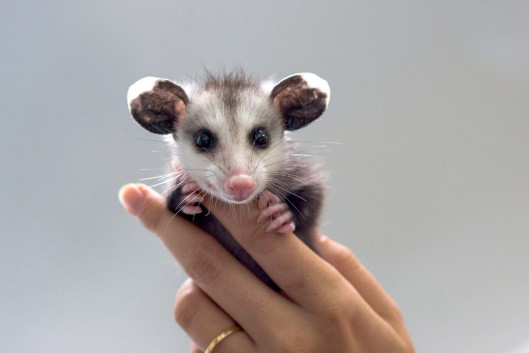
This photo is reprinted with permission of Nathaniel Kidd, please visit his website to see his beautiful nature photography www.nathanielkidd.com
The Opossum Society is quick to point out that opossums are not related to rats. They are marsupials, or “pouched” mammals, and are more related to the kangaroo.
--------------------
To learn more about these adorable animals, please visit their website at www.opossumsocietyus.org
…and we humans think having one is difficult.
Barry Kent MacKay is a bird rehabilitator and painter of exquisite bird art.
Each meticulous painting is accompanied by a detailed description of the bird, and the environment in which he thrives. Barry is also accessible for any questions.
As you can see, the Carolina Waterfowl Rescue helps all kinds of birds, kittens, opossums, etc. CNN gave them a well-deserved HUGE shout-out and posted many photos of their very successful latest campaign in which they put out their need for small nests for their bird orphans. The response was overwhelming with people from all over the world knitting little nests for them. They literally have thousands of nests now, so they are giving them away to other rehab groups that need them in addition to using them for young kittens!
Back in January, Wildlife Watch started getting hotline calls about a black vulture who was unable to fly (but could he run!) We rushed out with our cat carrier and trusty gloves, after enlisting the caller who said he could catch him if we brought the paraphernalia. The chase started with several people who were certain they could outsmart an incapacitated vulture, but he turned the tables on everyone and managed to get away by hopping, skipping, sprinting, and sort of flying over brambles and hilly, stony areas. Eventually he ended up in a neighborhood, blocks from where we had started off. Alarmed neighbors came out to see what was going on with so many people in their backyards. Then, they too became involved in trying to catch this wily bird. All efforts were to no avail. Days later, another call came in from folks who spotted the bird behind a restaurant, and by this time we suggested they call the best wildlife and domestic animal catcher in the business: Kevin Hindman. Kevin works with Missy Runyan of FFF Wildlife Center. He’s brilliant at humanely capturing the toughest cases and bringing them to FFF for treatment and release. Sure enough, after the fifth sighting, and Kevin’s relentless spirit, the bird finally found himself in a vulnerable place, and Kevin was able to capture him.
Missy sent this photo when he first arrived, and it appeared that the vulture was still strong. Missy reported that he had an old fracture and infection. Later she reported that “The fracture healed with nice alignment and the wing may be completely salvageable with physical therapy and antibiotics.” Well, we guess so since he was released in New Paltz sometime in April. She said he was a “tough one.” “Eat, puke, bark, bite…like treating a rabid dog.”
------------------------
Missy Runyan is founder of the Friends of the Feathered and Furry Wildlife Center. If you wish to help out with donations, you can visit these sites:
Alec Baldwin says: THE PATH TO A BETTER PLANET GOES ACROSS YOUR PLATE
Reported by CNN, Alec Baldwin uses his fame once again to talk about what’s needed to reduce the impact of our meat-based diet. The antidote? Veggies. It’s so simple.
Alec states that animal-based foods take up more than ¾ of the world’s agricultural land. Per gram of protein, producing beef requires 20 times more land than producing beans.
He points out that environmental degradation and destruction is caused by “extractive industries – mining, logging, and oil and gas exploitation, but points out that THE SINGLE LARGEST DRIVER OF LAND CONVERSION THAT’S PUTTING PRESSURE ON THE PLANET IS ACTUALLY MUCH LESS SINISTER: FOOD!!
He states that a shift to a more plant-rich diet can help save the planet.
And he asks, “Now what are YOU going to do about it?”
WARNING:
THIS PRODUCT “MAY CONTAIN FECES.”
Physicians Committee for Responsible Medicine (PCRM) wants the government to require meat distributors to put that notice on the food they send out to grocery stores!
The recommendation is tongue-in-cheek, but the group is serious about notification. The group represents 12,000 physicians whose mission includes promoting plant-based diets and ethical scientific research.
The truth is that animals are processed so quickly that it’s impossible to catch the fecal matter, which may or may not be visible.
WORLD PEACE DIET by Dr. Will Tuttle is a book that’s not to be missed. Please contact Dr. Tuttle to order and read about his many activities to spread the good effects of a plant-based diet.
Thanks to Humane Westchester for sending this encouraging news:
Pleasantville, a village in Westchester County, NY, is being true to its name by educating homeowners about how to live with coyotes, and how to recognize and avoid creating a dangerous situation.
The local government recognizes that residents need to keep pet food away from doors and not leave it outside. They are fair in pointing out that coyotes are very seldom aggressive toward humans. There’s more to it, and the full article can be read here:
Wildlife Watch sees this approach as being evolutionary in that the knee-jerk reaction has been to immediately kill any coyote who ventures into a suburban area.
“Fearsome Fake Coyotes” Don’t Help Their Image.
These fake coyotes are being used by the City of Newport Beach, CA, to keep sea lions from climbing aboard boats and docks at night, where they reportedly hold noisy parties.
To prove the accusation, someone grabbed the photo below.
Apparently, when many sea lions climb aboard, the boat sinks, which doesn’t exactly thrill the owners.
Marilyn Leybra, a coyote devotee, was furious to see that coyotes are being further demonized - and in such a wierd seting. She pointed out that coyotes are not natural predators of sea lions, but dogs could be.
A growling dog would be a more realistic deterrent.
A fake growling dog! How about it, Newport Beach?
Thanks to Gail Clark for sending the link. Please visit:
America’s national parks are our greatest treasure, and one oft-overlooked but unusually beautiful gem lies in the Red Rock country of Southern Utah. It is Capitol Reef National Park and it is not to be missed.
The Navajo called this beautiful parcel of colors “The Land of the Sleeping Rainbow.” I like to call it “Southwestern eye candy.” This 100-mile rainbow of towering rock is replete with canyons, cliffs, domes, and arches, plus waterfalls, streams, a river, and fruit orchards. It is great for wildlife watching since it is home to over 100 species of mammals, reptiles, amphibians, and fish; 239 species of birds; 900 species of plants (including some very rare, protected species) and 33 ecological systems.
Designated a national park in 1971, the park’s sculpted sandstone monoliths attract more than 784,000 visitors per year—maybe small compared to Bryce’s 1.5 million, but perhaps because it is not as well known. Must see attractions include the “Castle,” “Hickman Bridge,” “Cassidy Arch,” and “The Temple of the Sun” and the “Temple of the Moon” in Cathedral Valley. Just taking a scenic drive around Capitol Reef will dazzle the senses.
Dubbed “Capitol Reef” because its domes resembled the Capitol Building in Washington and its miles-long colorful ridge reminded prospectors of an ocean reef, the park is a time capsule of geologic history. Formed by a “waterpocket fold,” or “wrinkle” on the earth, the multiple layers of rock remain in time order, unlike other parts of the same Colorado Plateau, where time periods intermingle as mixed rock. The strata were formed by deposition, burying layers upon layers of the changing climates dating back to hunter-gatherer days—including desert, swamps, rivers, and even ocean! Later, plate tectonic uplift caused great monuments of colorful rock to rise from the earth’s surface, exposing nearly 200 million years of history.
Each period of time is another hue, colored by the minerals inside. There are the brilliant reds of sandstone, colored by iron oxidation (sometimes called “nature’s paintbrush) ; the limonite yellows of Dakota and Navajo sandstone; the seafoam green of the chinle layer (representing a time of swamps and lakes); the bright white layer of the Moenkopi and Carmel Formation; and finally the sprinkling of the grey basalt boulders, formed by a volcanic eruption in nearby Thousand Lakes Mountains.
Water is the major force that created this artist’s landscape: water erosion made the Swiss cheese-like holes that dot the landscape; water freezing and thawing pulled loose rocks down; water built the beautiful arches, domes and bridges that we enjoy today. And the landscape is forever moving and changing…centuries from now, it will not look the same.
Hiking here is a treat because of this diversity. The Freemont River and its waterfalls provide an oasis in the hot summer months. The orchards, originally began by Mormon pioneers in the 1880s, are well maintained and give visitors such delicacies as peaches, apricots, pears, and plums. The trails are well established and very different from each other. The landscape will change dramatically from the popular Hickman Bridge hike to the areas known as the “Goosenecks.”
During my August visit, I was graced with the presence of the gorgeous Monarch butterfly. They seemed to be everywhere I looked, their distinct orange and black pattern complementing perfectly with the hues of the rock they perched on. I was also treated to a visit from a friendly little chipmunk. Tired from the summer heat himself, he stretched his little body out on the rock and had a little nap right next to my crew and I as we rested our tired legs on the hike to Hickman Bridge. Mule deer are aplenty here, along with big horn sheep and mountain lions who also reside here, though sightings are not as frequent due to their furtive nature. Desert lizards scamper about and marmots sometimes pop up among the rocks. In the summer months, wildflowers abound in this amazing wilderness. No matter what month you visit, your camera will be busy snapping. And much like a river, you will never see the same view twice. It is always changing. It is always in motion.
Photo by Cynthia Hacker
Who knows what “The Sleeping Rainbow” will look like in 100 years, as the environment continues to shape and reshape itself?
Go see it now; it is not a place you will forget.
------------------------
Cynthia Hacker lives in New Paltz, NY. She spends her free time exploring the many wild places that grace the area. She is a writer and lover of nature, and an environmentalist.
------------------------------------------------
Editor’s Note:
The good news is that hunting is not allowed in the Capitol Reef National Park with its 241,904 acres, thus allowing the animals to live their lives in peace. Unfortunately, cattle-grazing is allowed. You will see cattle grazing along trailing routes. Wildlife Watch has found that some of these peaceful animals have starved to death for lack of the food they require. Using public lands for cattle grazing has been extremely controversial. With climate change being the number one concern of Americans, hopefully this practice will change. For everyone’s sake, it had better.
------------------------
For more about the controversy surrounding cattle grazing at the Capitol Reef National Park, please visit the following links:
With spring in full swing, it is such a pleasure to have a natural space, free of human interference, to meld with when the forest calls. Located on River Road, just ten miles outside of New Paltz, NY, and encompassing ninety-six acres, the Esopus Meadows Preserve is a beautiful oasis of trees, pathways, and shoreline, all woodsy and left to wild abandon. On the quietest days you will see large hawks and falcons sailing on placid winds far overhead. As the sun dips to earth, you can hear coyotes crooning to each other in the twilight. Nobody arrives armed with guns; this is not a place for man’s massacre. It is a forest for strolling on their endless trails, or going off-route to notice a still pond and listen for peepers, to pet moss, to watch chipmunks and squirrels wrap themselves around trees gracefully and play statue at the first sign of movement.
When you first enter the preserve, you immediately face a choice: a path that takes you along the coast of a huge shimmering lake, or a path that draws you into the forest. As you walk by the shore there are miniature beaches with shells, driftwood, and occasionally a bench where you can sit and feed ducks. If you choose to trek into the woods, there are no seats, no signs of human interference aside from a few trail markers on trees that you can follow or disregard. Deep into the forest you can hear birds chortling, squirrels unearthing their acorn bounty, and the chorus of frogs.
I climbed a large boulder to find a clearing where I saw, high up, a red-tailed hawk soaring so gracefully on a tailwind, as close to the clouds as she could touch. Peering toward my feet I saw enormous ants working hard to carry food to their queen. The natural and nearly primal feeling of being surrounded by wildlife never ceases to amaze me, to awaken an urge to succumb to the woods. This spring, if you get a chance, saunter through the heavenly Esopus Meadows Preserve. You just may find magic there.
------------------------
Lily Wolf was born and raised in New York City. While a student at SUNY (State University of New York) New Paltz, she experienced the beauty of the New Paltz area. After graduating and returning to NYC, she missed the natural world. So, rather than yearning for nature, she moved to the area to make nature a part of her daily life.
For three days an adorable little three year old boy was missing. He lived in a rural area of North Carolina and was out playing with friends when he disappeared. Authorities, including the FBI, NCIS, volunteers and the US Marine Corps, joined forces to find the little guy.
As the days passed, concern grew for Casey who faced vines, thorns, and inclement weather that dipped to 20F at night and rained during the day. You can imagine that the family was frantic. Fortunately, on the third day, Casey was found when rescuers heard him call out for his mom.
When he was asked about what happened, he said that he had a friend with him - a bear!
The authorities were in disbelief and thought perhaps he had become delusional from the trauma, so they gave him a “forensic psychological exam.” They found nothing conclusive to verify his report, or to show otherwise.
Photo published with permission of photographer Rona Schwartz
But we ask why that would be so difficult to understand. Black bears are vegetarian animals. I can vouch for the fact that they can be playful and not threatening. Alone in a remote area of what used to be the Catskill Game Farm, I noticed a bear teenager who darted behind trees and poked his head from behind a tree as I was walking. He kept pace with me and continued to move from tree to tree poking his head from behind the tree as though to play hide-and-seek. He even seemed to have a little grin on his face.
Yes, I believe that Casey had a friend out there, it wasn’t unlikely, and the bear could have helped Casey get through those days by keeping him company.
The sheriff apparently took it seriously also. Considering the conditions, he said he believed the kid was looked after and his survival was a miracle. “I don’t know if that meant he saw a bear,” Hughes told WCTI. “I don’t know if that meant a bear embraced him or what it meant. I thought it was a very cute story, and if that’s what helped that child survive through this, you know what, I’m to going to embrace that story that came from a three-year-old, to his mom, to us.” Wildlife Watch has put a call in to the Sheriff’s office to see if they had the result of the test back, but we haven’t heard from them yet.
His mother was later interviewed and she was asked if she believed his story that a bear had kept him company, and she said matter-of-factly, “If he said that, it has to be true.”
Everyone has now seen the famous internet photo of the beached whale with a stomach full of plastic bags, the heartbreaking photo of the sea turtle with a blue plastic bag protruding from his mouth, or worse yet, the video of the poor sea turtle, in obvious pain, getting a plastic straw removed from its nostril. We know there's a problem—there's a plastic garbage patch in the middle of the Pacific Ocean the size of Texas—but what can we do? It is only growing worse, with 800 million tons of plastic being produced every year, it is said that in the future, we will have more plastic than fish in the ocean. Let that sink in for a moment.
How does it get there?
When we throw our household garbage out, we expect it to go to landfills, not the ocean. So how did it all get there? There is an excellent “mockumentary” on the internet called “The Majestic Plastic Bag.”
It shows the journey of a plastic bag as it makes its way “home” to the Pacific, the satire being that this is indeed, not its home. It doesn't belong there. Over 80 percent of the garbage in oceans comes from the land—our beaches, streets, highways. Wind blows our everyday household trash into storm drains, and waterways, and eventually out to the ocean. Trash that awaits disposals in landfills often sits on harbors, waiting to be shipped, and is blown right into the water. Even trash we tie up can become unsecured, and be caught by wind as it is transported to what we think is the proper spot.
The Impact
Over 100 million marine animals are killed each year due to plastic debris in the ocean. This includes sea turtles, whales seabirds, fish, and coral reefs. If a sea turtle consumes plastics, they become trapped in their stomachs. Because of their downward facing spines, they cannot regurgitate them, nor can they swallow anything else. Horribly, they begin to float because of the gas it causes their system, and they die of starvation or from predators who can now see them. Conversely, a whale or dolphin that becomes entangled in a fishing net that has drifted will also starve. The process will take months because of the amount of fat their bodies have stored.
The most sinister aspect of plastics is that they are truly forever. They take years to break down, and when they do, they break down into smaller, more toxic pieces. They are ingested easier and are perfect hosts for species which are then carried out to other parts of the ocean. In addition, as they decompose, they release toxins into the water, which become part of the food chain.
Humans “get back” the plastics we’ve thrown out in not only the fish we eat, but through the animals we eat who eat the fish! Plastic can never truly be “thrown away” and forgotten.
What can we do?
Again, most of the trash in the ocean is recognizable: it's our plastic bags, straws, bottled water, To-Go cups, packaging, even balloons. The first, most important thing we can do is reduce our consumption of single use plastics. Carry a reusable bag, drink water from a reusable container, and think hard about not using straws anymore. Even chewing gum has a type of synthetic plastic in it! It takes effort to change our habits but many communities have already banned plastic bags and straws, and many restaurants are moving toward biodegradable packaging for To-go items. Innovators have begun to produce alternatives to plastic products. You can reduce your impact by buying biodegradable products like bamboo toothbrushes, or reusable straws, cutlery, and containers for travel. If you have a baby, consider washable cloth diapers.
For ideas on products that are alternatives to plastics, visit https://www.onyalife.com/. There are many more sites like this out there. This is just one place to start.
Other ways you can help include:
Properly secure garbage
Participate in beach clean ups and other community clean up events
Support bans on single use plastics like straws and plastic bags
Even though you think it might be a nice commemoration, do not release balloons in the air
Volunteer at marine life conservation and rescue organizations. www.wildhawaii.org offers internships and opportunities to volunteer during a visit to Hawaii.
Cynthia Hacker lives in New Paltz, NY. She spends her free time exploring the many wild places that grace the area. She is a writer and lover of nature.
According to reports by researchers, drivers in relation to animals hit and killed by cars can be lumped into three categories: those who lament seeing roadside corpses, those who are indifferent, and those who go out of their way to deliberately injure animals in the road. When it comes to the latter group, their motivation may be construed as being within the realm of “population control”, but in many cases, it is a streak of pure cruelty. An innocent creature navigating through modern man’s world is at an unnatural disadvantage, and some drivers may take advantage of their opportunity to injure or kill them. The evil of man never ceases to amaze. An experiment involving fake reptiles put this cruelty to the test.
A 2017 study by Mark Rober explores the relationship between species and intentional hit-and-runs. Using rubber animals as stand-ins for the real thing, he placed ersatz turtles, snakes, and tarantulas on the shoulder of the road to prove his hypothesis that people will swerve to hit more turtles than snakes. While 3.2% of drivers aimed for the tarantula, only 1.8% went for the snake, and a mere 1.0% for the turtle – statistics which Rober says proves they are “cold-blooded rubber animal killers.” The good news is that a higher number of drivers attempted to rescue the animals: 4% tried to save the turtle, and 1.7% reached out to the snake. Even animal control pulled over to help! He had to reject his own hypothesis, but was all the same pleased to see some people reaching out with care. You’ll find Rober’s findings at faunalytics.com: “Intentional Vehicle Wildlife Collisions.”
The formation of Rober’s hypothesis was based on a 1989 Kansas experiment by scientists Langley, Lipps, and Theis “using black snake models, blue snake models, and a black hose.” This time the fake creatures were placed on the mid-strip of the road to ensure that drivers were in fact going out of their way to hit the animals. 2.7% of drivers intentionally ran over the models, while 3.3% stopped to rescue them. When model turtles were introduced to the lineup in a 2007 Canadian study by scientists Ashley, Kosloski, and Petrie, it showed the snake was hit 1.4 times more than the turtle, but also saved 1.1 times more.
In a 2011 Australian study by Beckmann and Shine suggested another possible outlet for drivers’ hit-and-runs was their rationalizing and self-aggrandizing belief that they were invasive species cleansing. Drivers were asked if they would intentionally run over snakes, turtles, or cane toads. The latter are considered to be an invasive species in the area. A whopping twenty-five percent attested they would run over cane toads. However, in the set-up experiment, it was found that cane toads were hit no more or less frequently than turtles and snakes. It would seem the claims people made about their “noble” desire to hurt animals did not quite hold up under scrutiny.
Though there are people who will go to lengths to kill animals, there are even more who care enough to keep animals away from harm. It appears so bizarre that people would harbor hatred in their hearts to the extent that they would kill a fellow creature, but inspiring that there are those who help to rescue – proving that more humans have good in their hearts than not.
Lily Wolf lives in the Hudson Valley in New York State. She researches and writes for Wildlife Watch and works with other animal protection organizations.
Laysan Albatross necropsy photos, showing cigarette lighters, bottle caps and more. Smithsonian Institute. Museum of Natural History.
In an area halfway between California and Hawaii, ocean currents and winds drive marine debris into a swirling dynamic area that has become known as the “Great Pacific Garbage Patch (GPGP). It is the largest of five oceanic garbage patches, or gyres, weighing in at 80,000 metric tons with some 1.8 trillion pieces of plastic, everything from derelict fishing gear to plastic bottles, straws, construction debris, toys and more. The Ocean Cleanup Foundation is reporting that the GPGP is now a shocking 600,000 square miles in size. A 2015 study found 16 times more plastics and debris than earlier estimates, while scientists believe an “exponential growth” is occurring as debris from Asian nations as well as North and South America continues to accumulate.
Where does all this trash come from? Shipping and cargo vessels contribute by dumping cargo (either deliberately or by accident), cruise and recreational ships directly offload waste while fishing vessels drop unwanted, non-functioning items overboard, including fishing gear, traps and ropes. Meanwhile, careless beachgoers leave litter and food packaging on the sandy shores, while the outflow of rivers carries the throw-away refuse of human society into the oceans. In one of the most mindless littering activities, millions of balloons are released in any number of sporting, memorial, entertainment or celebratory events, often traveling hundreds, if not thousands of miles until they fall, 72% of the time, into a body of water. Plastics and other synthetic materials have become ubiquitous, and their effects on the environment and wildlife have become catastrophic.
Synthetic materials, aka “plastics” began their conquest of the human experience in the early 20th century. Products made of nylon, styrene and more were viewed as the height of progress and luxury. They provided convenient wraps for food and other products, and were easily molded into containers, eating utensils, automobile parts, even medical devices. Now ubiquitous, we can’t shed our dependence or find solutions for the massive amount of waste that these eventually broken and unusable products generate. We are used to our “throw away” products, our pens, cigarette butts, plastic shopping bags, and the easily forgotten litter they generate.
MARINE ANIMALS SUFFER THE CONSEQUENCES
What does all this mess mean to marine life? While fish populations have been crashing around the world with amounts of biomass in decline, the infusion of plastic and debris has been growing non-stop. Meanwhile, in a never-ending search for food, hungry marine animals, everything from whales to snails and all those in between, are consuming the trash.
Just consider latex balloons, which may take 6 months to several years to decompose, plenty of time to kill marine organisms. Partygoers witness the 20 second “thrill” of seeing them rise and disappear; then balloons will burst and fall, usually with ribbons and strings attached. To a sea turtle, the flexible floating balloon pieces and trailing threads resemble plankton, a preferred food. How many floating deflated balloons or plastic bags have killed sea turtles, all species of which are endangered, we will never know.
Just last week we learned of the sperm whale that washed up on an Indonesian beach. A necropsy showed the whale had died with over 13 pounds of non-food items, aka, trash, in its gut:
A dead sperm whale [was] aground on a shore in central Indonesia had digested over 1,000 pieces of plastics or nearly six kg, Wakatobi district national park chief Heri Santoso said on Wednesday.
The park chief said that the items found in the stomach of the 9.5-meter long mammal included 115 drinking cups, 4 plastic bottles, 2 flip-flops, 25 plastic bags and over 1,000 assorted pieces of plastic, reports Efe news.
Like turtles who consume synthetic materials, whales and dolphins will fill their stomachs with trash while looking for food. If the particles don’t become lodged in internal organs, which can cause blockages and death, the animals may actually starve to death with a stomach full of indigestible debris.
A seal is trapped in a deadly tangled nest of discarded fishing gear and nets.
(Photo: NOAA)
Shock, combined with a little wonder at the unnatural. That’s how I feel as I watch the knife slice through the sternum of a dead Laysan albatross. Inside its ribcage: a sickening array of plastic. A red bottle top from a well-known soft drink brand. A cigarette lighter. Or two. Long thin items I couldn’t begin to identify. It looked like the bird had swallowed the contents of an entire trash can whole.
Yet this wasn’t because it dined on a refuse site. I was on Midway Island, in the remote Pacific Ocean, at least 1,500 miles from the nearest one of those. This disgusting and otherworldly sight exists because we’re throwing the equivalent of one garbage truck of plastic into the oceans every minute. By 2050, a number of researchers expect the world’s oceans to contain more plastic than fish, by weight.
Research at the Institute of Biogeochemistry and Pollutant Dynamics in Switzerland found microplastic ingestion even by base of the food chain plankton:
Each year, millions of metric tons of the plastic produced for food packaging, personal care products, fishing gear, and other human activities end up in lakes, rivers, and the ocean. The breakdown of these primary plastics in the environment results in microplastics, small fragments of plastic typically less than 1-5 mm in size. These synthetic particles have been detected in all of the world’s oceans and also in many freshwater systems, accumulating in sediment, on shorelines, suspended in surface waters, and being ingested by plankton, fish, birds, and marine mammals. (Research Highlights: Impacts of microplastics on plankton. https://www.ncbi.nlm.nih.gov/pubmed/26829584)
Scientists are confirming that now microplastics are being unavoidably swallowed by tomorrow’s “seafood”. That means if you consume fish, your body is most likely harboring microplastics, too. Microplastics can be as small as any length of thread, an ant, a sesame or poppy seed and are often too small to see with the naked eye. At this size they may easily lodge undetected in the tissue of seafood products like lobster and salmon headed for market.
The amount of trash being dumped into our oceans is staggering, and the problem continues to get worse.
In a more direct route, boaters may dump their trash right into the sea. In the past, this has been the main cause of plastics in the ocean. In 1975, the National Academy of Sciences estimated that 14 billion pounds of garbage was being dumped into the ocean every year. That’s more than 1.5 million pounds per hour. More than 85% of this trash was estimated to come from the world’s merchant shipping fleet in the form of cargo-associated wastes. According to the Academy, the United States could be the source of approximately one third of this ocean pollution.
By 2016, the World Economic Forum found the tonnage of marine debris had increased to ~25 million tons per year, a number still expected to rise:
A full 32% of the 78 million tons of plastic packaging produced annually is left to flow into our oceans; the equivalent of pouring one garbage truck of plastic into the ocean every minute.
If we carry on as usual, this is expected to increase to two per minute by 2030 and four per minute by 2050. By 2050, this could mean there will be more plastic than fish in the world’s oceans.
As part of an international treaty, in 1988 the Marine Plastic Pollution Research and Control Act (MARPOL) was established, making it illegal to dump plastics into the oceans. But the law is almost impossible to enforce and doesn’t address the thousands of miles of driftnets, ropes and fishing gear “which can ensnare and kill birds diving for the fish below, or come loose, only to be discovered later by an unfortunate humpback whale.” (Woods Hole Oceanographic Institute.
This green sea turtle was weighed down by a masssive fishing net.
(Photo: NOAA)
How is anything supposed to avoid ingestion?
WHAT CAN WE DO?
Although the slogan may seem cliché, “Reduce-Reuse-Recycle” is good advice. Simply using and buying less, fixing, repurposing and reusing what is already in hand, and recycling what is allowed can do a lot to address the problem. Avoid those single-use products like straws, plastic bags and utensils. Encourage officials to invest in enforcing those neglected anti-ocean dumping laws. If we all did our part, we would have less of a “plastic ocean catastrophe” on our hands.
Plastics? Throw away trash? “We need it,” the makers of plastics say. “We can’t live without it!” Well, if I were a fish, I would beg to differ.
For the past seven years Augie has had a very important job to do; to humanely remove Canada geese from the campus of the State University of New York at New Paltz. You may have read about the wonderful Augie previously, in a summer 2011 issue of the Binocular. We checked in with Augie’s parent, Mike Malloy, to see how Augie is doing and how his job has evolved over these last seven years. It seems that Augie has taken on some new and interesting responsibilities.
It is still Augie’s primary job to herd geese away from campus ponds and fields, but his introduction to the campus has been so successful that his work load has lessened. Mr. Malloy has said that the geese mostly avoid the campus, and no longer nest there, ever since Augie started working. Augie’s other important roles on campus include welcoming incoming students at orientation, being the face of the school’s winter clothing drive, and visiting students at residence halls to relieve stress during finals. Outside of the college campus, Augie is part of a nation-wide program at public libraries. These programs use dogs to help children read aloud by being there to listen and encourage them. For his work with children, Augie has become a certified therapy dog.
As if Augie wasn’t famous enough, he now has two children’s book written about him by SUNY New Paltz English Professor Rachel Rigolino. One titled “Augie Goes to College” chronicles his travels from the rescue farm he lived on to his job at SUNY New Paltz. Another titled “Augie Goes to the Library” tells the story of his job helping children learn to read aloud. Augie even had a role in the college’s theater production Fat Ram, where Augie barked at a villain on stage. Mr. Malloy has confirmed what we could all assume, the campus community at SUNY New Paltz loves Augie!
In July 2019 Augie will turn 12 years old. Soon he will be retired and enjoying a relaxing life with his dad, but the message of his important work will live on. Augie and Mr. Malloy are real life examples of how humans can find ethical solutions to human/animal conflicts. There are plenty of beautiful geese, ducks and other waterfowl that grace the SUNY New Paltz campus, and with Augie now on the job, these birds can visit, but avoid taking up permanent residence. This allows the college to save money by avoiding the cost of cleaning up the waste the geese would leave behind. Augie is very well trained, and knows to leave certain kinds of birds, like ducks, alone and never hurts any of the geese he herds away. We thank Augie and Mr. Malloy for the wonderful, inspiring work that they do and the amazing example that they set.
————————
Marissa Guercio is a recent biology graduate, naturalist and all around animal lover. She is interested in animal behavior, conservation, philosophy, and how humans can better interact with the natural world. It is her belief that the ability to live in harmony with nature and wildlife exists in all of us, we need only the proper tools and knowledge.
In April, a terrible incident happened in Central Delhi. The initial report was that a 12-day old baby was grabbed from his mother by a monkey. That the monkey ran off with the baby was the only account that didn’t have conflicting reports. Several stated that the baby was severely bitten in the face. Another report said that the police came and threw rocks at the monkey to get him or her to drop the baby. But other reports said that people in the town were throwing rocks immediately. It’s hard to know what was happening in the chaos that ensued, but the story that was popularly reported was that the baby was severely bitten in the face by the monkey. Even early reports of the place where the baby was found were different: one said the baby was found in a well, another report said the baby was found on a rooftop.
In the throes of a violent event among humans only, there are two sides to the story, or mitigating reports of what may have occurred that could lessen a sentence for a human. In no way would anyone condone violent behavior just because an animal has committed the offense, but knowing the truth should be a goal. Animals have the cards stacked against them as they’ve no way to communicate a contradiction of false or confused accusations. It was reported in one article that the mother felt the monkey intentionally dropped the baby in the well, in another the father thought the monkey dropped the baby while fleeing.
What would have happened to the monkey, even all of the monkeys, if such an event had occurred in another country, but in Hinduism, monkeys are considered deities. The government’s response was to use immunocontraception to reduce the population of monkeys, and to find the one monkey who snatched, and allegedly killed the baby. Wildlife Watch is in awe that the government had the good sense to not blame the other peace-loving monkeys. Taking a broad brush to paint an entire population, and not seeing the individuality of animals, happens all too often elsewhere.
We were further struck by the sympathy for all that was expressed by the government in pointing out that the environmental degradation of forest lands, where monkeys would normally live, have forced monkeys to find food and shelter in more populated areas. As we researched reports about this terribly sad and disturbing incident, we found that reports of monkey attacks on humans varied from being called “a rare occurrence” to being called “second only to dog attacks.”
In the monkeys’ defense, one report said that “While monkeys attacking humans or entering houses in search of food are fairly common, this is the first case in which one has run away with a baby.” [This indicates that attacks of this nature are rare.] In that same report, it quoted a doctor who had examined the baby’s body and said, “there were no serious injury marks.” [This finding indicates that the baby was not attacked as had been described.]
The doctor said it appeared to be “a case of asphyxia due to drowning…”
None of the above can ever bring the baby back or dampen the shock and pain of the parents and the community. The question is what should be done to prevent such an occurrence in the future, and for that we need the truth.
The species Homo sapiens woke up this morning to a sudden collective realization that they are plant eating primates, not some Tyrannosaurus-like super predators. Instantly, as if waking with a start from a bad dream, it came to each and every human at exactly 8:00 a.m. that all their problems would be solved if they changed their carnivorous ways.
By day’s end, with the whole of humanity now born again vegan, people begin to feel better than ever—revitalized—with a glow of guilt-free contentment. World hunger eases and peace seems actually attainable since folks have moved beyond their longing for animal flesh. And the once hunted and farmed animals rejoice, knowing that two-leggers are now treating them with fairness and respect.
It’s been a long time coming and not a moment too soon. This day will be known as Happy Vegan Day, a time when all people exchange cruelty-free gifts in honor of the glorious occasion.
————————
Jim Robertson is author of Exposing the Big Game: Living Targets of a Dying Sport.
The Erie County SPCA in Seneca Falls, NY is a unique SPCA in that it actually has a wildlife division that’s extremely active all year. With veterinarians and medical facilities at their fingertips, they are able to do a lot of good for the wildlife.
It should serve as a model for SPCAs everywhere. We hope that in the next issue of the Binocular, we will have an article addressing that goal.
A photo of a little opossum patient from their gallery taken prior to the fire.
After the horrific fires devastated large swaths of forested land in California, Wildlife Watch called numerous wildlife rehabilitators and facilities in the areas that were in or close to the extreme fires. We wanted to see how we could help in some way to direct contributions to them for needs.
The reality of the destruction hit home when we did not hear back from anyone for days. The rehabbers also needed to evacuate to keep from being consumed by the flames and overcome by the smoke. Even the California Department of Fish and Wildlife couldn’t provide any information about the wildlife or who was in a position to take in wild animals affected by the fire. They provided one name, and when we called, the man said that he wasn’t able to continue his work and didn’t know of anyone who was.
Then on November 27th, we got a call from the California Wildlife Center http://cawildlife.org/ in the Malibu area. They explained more about what it was like in the front lines. She said that because people were fleeing the area, there was no one there to report injured wildlife, so they actually hadn’t received calls. She said that as people begin to return, they are sure that calls will come pouring in.
If you would like to help them for that inevitable time in the near future, please contact California Wildlife Center http://cawildlife.org/
We will report anything more that we find out. If you are in a fire-ravaged area, and you know of rehabbers who are helping there, please let us know so we can inform our readers about how to help.
Here in the Hudson Valley, we are a little spoiled. We are used to beauty and color, and lots of it. Tourists come here in droves just to see our autumn leaves, and our bright, summer season isn’t too shabby, either. However, 2018 has been a little, shall we say, “on the grey side.” An elongated winter turned into a bright sunny, summer filled with promise. Then, something happened. After a gorgeous July 4th, we fell into a deep spell of grey—little bits of scattered sunshine overshadowed by rain, rain, more rain, and well, grey. Fall hasn’t been much different. The rain has essentially pulled the leaves off the trees early, leaving them to land in pools of water and mud, barely colored. If you’re like me, this prolonged weather pattern has left you feeling a little grey. The rain has kept me indoors more and the lack of sun has me browsing Amazon for a Happy Lite. As weekend after weekend brings cold, wet weather, I’m even missing the tourists, a little.
Last Saturday I had enough. I needed outside. I didn’t care that it was cold, dark, rainy, and windy, I needed to be walked as badly as a restless labrador. I set out on my section of the Wallkill Valley Rail Trail, donned in my raincoat, rainboots, and scarf-hat-and-gloves combo, and tried to ignore the rain pelting my eyes. Then something happened. I began to notice the beauty in the grey. First, I was lured by the sound of water, as what was normally a small tributary of the Wallkill River now became a raging chorus of whitecaps and rapids. Trees lining the trail were a little bare, but on the ground was a carpet of leaves the color of a rainbow, and it seemed to glow against the backdrop of the foggy grey sky. It was mesmerizing! And what made it even more special was that I was alone. Who would be out here on a rainy, cold day? But it was beautiful. All the rain has made for lush green grass and I had never seen that creek so high and mighty. The water looked almost inviting, so clear and deep. I knew the small waterfall up a ways on the left of the trail would now be an impressive site to behold. I couldn’t wait to see.
I whipped out my cell phone and began taking pictures of the water, the trees, even the ground. I always wondered how people could take photos of leaves on ground and make them look good, but then my eyes caught how the leaves seemed to sparkle in the water, and the drops of rain created rings in between them in the most fascinating way. I found myself stopping, staring at the ground, waddling around taking photos of the ground, on a path I walked nearly every day. What had changed?
I invite you to check out the grey. Grey can be exciting. And there’s lots of it. Witness the joyful behavior of the grey squirrels, who are out there all day, in all kinds of weather, not only making their living, but, when one takes the time to notice, actually playing with one another. Then there are the grey and black chickadees that stay with us in the north, along with the mourning doves, who sing a beautiful song no matter what the sky brings. A dreary day can turn into a beautiful one if we just stop and look around a bit.
I’m glad I took the time to get out of the house that day. To look beyond my expectations of beauty. To change my perspective. To find beauty in the grey.
———————— Cynthia Hacker lives in New Paltz, NY. She spends her free time exploring the many wild places that grace the area. She is a writer and lover of nature, and an environmentalist.
I was so enraptured by my first trip to Myakka River State Park, that I felt a longing to return a few days later. I chose to visit at the 8 am opening. There were only a few other people at that hour. I drove 5 miles an hour through the park with the windows open so that, perhaps, I would be able to see or hear wild pig or deer walking through the forest. Many trees are covered with the iconic Spanish moss, an air plant which receives nutrients and water through its surface.
Alligators can be seen basking on the banks of the Myakka River. From afar, they look like logs. It is really thrilling to see this prehistoric creature, not far from people in the park.
Alligators sometimes swim together, during mating times, as well as touching snouts. Males can be observed putting their heads on the backs of females. At times of high-density congregations, alligators sometimes engage in the cooperative feeding of fish, though they are usually solitary. They can live to be as old as 75 years.
At the end of the “bird walk,” reached by a short wooden bridge over a grassy area, there were usually 2 or 3 bird watchers with high-powered scopes, focused on a specific area. They are very generous about offering to let others see through the scopes,which are on tripods. I was able to observe Blue-winged Teal, Glossy Ibis, Short-billed Dowitcher, Golden Eagles and Caspian Terns. I would never have been able to see these birds without the help of a scope. I regretted not having my binoculars with me. A mistake I will never make again.
Without the help of binoculars, I was able to watch Roseate Spoonbills, sifting below the surface of the water with their spoon-like beaks, in a back and forth motion, to feed on shrimp, small fish, snails, mollusks, as well as insects. Roseate Spoonbills are very rare in the park. I also saw Great Egrets, Ospreys, a pair of Sandhill Cranes, Great Blue Herons, Black Vultures, and Cormorants fishing underwater.
The only snag in my otherwise sublime visit was the incongruous presence of alligator meat on the menu in the park cafeteria. Especially since next door was a boat tour to see nature, including alligators. I shared my opinion on this subject and hope that in time public outcry will compel them to take these endearing reptiles off the menu.
————————
Chris Arenella has lived and travelled in more places than we can count. She is also formally studying more about nature and wildlife at the wonderful courses offered by the New York Botanical Garden.
EDITOR’S NOTE: Wildlife Watch is changing its policy of not promoting places to visit where hunting is allowed. We will instead be letting our members and readers know about these otherwise wonderful areas and encourage everyone to make their feelings known via letters to the editor, politicians, and the parks themselves that hunting and trapping and using the wildlife as food has no place in a civilized society, and can ruin the experience of people who are visiting te park.
Pilots to the Rescue’s mission is to save pets facing potential euthanasia using a specially equipped plane, enrolling a network of trained pilots, shelters, ground teams and veterinarians. Top Dog, Michael Schneider says, “PTTR flies these little souls filled with unconditional love giving them a second chance for a furever home.” Pilots to the Rescue is a registered 501(c)(3) non-profit all volunteer organization.
Their first plane is a 6 passenger plane that can carry approximately 1,000 lbs and has great bay loading doors for larger cages and the seats can easily be removed. It cruises close to 200mph and has a 5 hour endurance. Perfect for sub 1,000 mile ranges (from NY).


 In July 2019 Augie will turn 12 years old. Soon he will be retired and enjoying a relaxing life with his dad, but the message of his important work will live on. Augie and Mr. Malloy are real life examples of how humans can find ethical solutions to human/animal conflicts. There are plenty of beautiful geese, ducks and other waterfowl that grace the SUNY New Paltz campus, and with Augie now on the job, these birds can visit, but avoid taking up permanent residence. This allows the college to save money by avoiding the cost of cleaning up the waste the geese would leave behind. Augie is very well trained, and knows to leave certain kinds of birds, like ducks, alone and never hurts any of the geese he herds away. We thank Augie and Mr. Malloy for the wonderful, inspiring work that they do and the amazing example that they set.



 I invite you to check out the grey. Grey can be exciting. And there’s lots of it. Witness the joyful behavior of the grey squirrels, who are out there all day, in all kinds of weather, not only making their living, but, when one takes the time to notice, actually playing with one another. Then there are the grey and black chickadees that stay with us in the north, along with the mourning doves, who sing a beautiful song no matter what the sky brings. A dreary day can turn into a beautiful one if we just stop and look around a bit.
