

Alligators: Guilty Until Proven Innocent” – Page 4
In Hurricanes, What About Animals?
THE NYS DEPARTMENT OF ENVIRONMENTAL PROTECTION PLACES MUTE SWANS IN THE SAME CATEGORY AS FUNGI AND ALGAE

THE BELOVED MUTE SWAN IS A PROHIBITED INVASIVE SPECIES.
Sadly, the New York State Bureau of Wildlife (BOW) has passed regulations to kill all upstate mute swans and cripple downstate swans near New York City to keep them from flying. In order to understand how devastating crippling must be for a swan, try to walk in the shoes of a bird who can not fly.
The Special Licenses Unit of the DEC gives licenses to wildlife rehabilitators. On December 2, 2015, they sent a letter to all licensed rehabbers in NYS that contained this message:
Invasive Species. Mute swans will not be allowed to be released to the wild following rehabilitative care. In 2015 the Department adopted the Prohibited and Regulated Invasive Species regulation 6 NYCRR Part 575 (http://www.dec.ny.gov/regs/2490.html). The new regulation lists mute swans as invasive species and prohibits their release to the wild. Any mute swan received for rehabilitation must be: (i) transferred to a person licensed to possess live wild mute swans, or (ii) euthanized

SO, ALONG WITH KILLER GREEN ALGAE

SIREX WASP FUNGUS
ONLINE COURSES PREPARE STUDENTS FOR THE COMPANION ANIMAL FIELD

A Pet Education Certificate has been announced by the Continuing and Professional Education Division of SUNY ULSTER.
The brochure states:
For those interested in starting a career working with animals but do not know where to get started, this course will help students explore the field of animal-related careers through education and internships. The Pet Education Certificate course offers a variety of resources to help begin or enhance their career working with animals including but not limited to pet-sitting, kennel work, daycare, training, working for a veterinarian and other animal-related fields. The course content includes: pet health and illness, communication, behavior management, safety, basic hygiene care for pets, and even writing a resume and preparing for an interview. This course will further a student’s knowledge and skills through course lectures, guest speakers and hands-on internship experiences. Those who successfully complete this unique program will have specialized education and experience that gives them an advantage in the field. Internships can be a good source for students to network for experience and employment. In order to successfully complete this program students must complete a pet First Aid/CPR class and at least 54 hours of internships at approved animal care facilities (instructor will assist students in securing the necessary internships) within six months of the final class meeting. 7.2 CEUs
For more information contact SUNY ULSTER, Kingston Center, at 845-339-2025 or visit: http://apps.sunyulster.edu/courses/DCB,2004
Let’s Go Wildlife Watching
The Nyquist-Harcourt Wildlife Sanctuary
The Nyquist-Harcourt Wildlife Sanctuary is nestled in the historic district of New Paltz, NY. If you are in the area, enjoy a visit to the sanctuary to get away from the maddening crowds during the summer. You will also learn a lot about New Paltz‘s Huguenot history when you further visit the area.
On their website, they describe aspects of the Sanctuary:
The flood plain forest is an especially rare ecosystem regionally that serves as a habitat and travel corridor for many animal species.
140 species of birds in and around the sanctuary have been observed over a 12-year period. 36 are on the Audubon list of birds of conservation concern in NY.
The sanctuary contains about half an oxbow, a complex of ponds and wetlands remaining from a tightly curved meander cutoff when the Wallkill River straightened its course.
This lovely sanctuary serves as a model and example of how land and wildlife can be protected right in the middle of otherwise busy areas. It provides solace and enjoyment for those who wish to escape from the shops and restaurants and be with nature.
Visit: http://www.nyquistfdtn.org/nyquist-harcourt-wildlife.html
TAIWAN BANS CONSUMPTION OF DOG AND CAT MEAT


President Tsai campaigned with photos of her cats and spoke out for animal protection throughout her campaign.

President Tsai Ing-wen’s cats, Think Think and Ah Tsai, going at it.
Taiwan already had a national Animal Protection Act that prohibited the slaughter and selling of dog and cat flesh. In April, an important amendment was added: the prohibition of the consumption of dog and cat flesh!
…and the fine is hefty: $1,640 and $8,200. Further, anyone convicted of intentionally harming or torturing animals can face two years in jail and a $65,000 fine! Taiwan is not kidding!
Violators may also see their names, photos and crimes publicized, according to Taiwan’s Central News Agency.
Some forces that contributed to the new amendment include thousands of names on petitions that were sent to the government; the growing number of dog and cat “owners” in Taiwan. These dog and cat guardians have become sensitized to the animals, and now view them as the individuals they are; of course, the main person to thank for the law is President Tsai Ing-wen, who herself is an animal lover.
President Tsai adopted three retired guide dogs together, and promised to pass a law that would remove the restrictions that keep them from many public places. President Tsai is hoping that as the dogs are allowed to enter properties from where they are currently banned, more people will have seeing-eye dogs, and that will also provide homes for the dogs.
RUMORS AND SUPERSTITION CAUSE PRIMATE DEATH!

Obviously, these precious animals’ voices need to be heard. You can help them. See the information below this article.
The Duke Lemur Center in North Carolina welcomed, Elphaba, a baby aye-aye.
See the slender fingers of the aye-aye.
As if ceaseless environmental destruction isn’t enough to cause so much misery to wildlife, rumors and superstition seem to be putting the finishing touches on.
Unfortunately, for humans and monkeys alike, there is a yellow fever outbreak in Brazil. While the disease is caused by mosquitoes, howler monkeys are falsely being blamed for it.
According to http://www.cnn.com/2017/05/05/health/brazil-monkeys-yellow-fever/ Roberto Alves is manager of the Vectorially Transmitted Illnesses Technical Vigilance Unit at Brazil’s Health Ministry. He is tracking the outbreak and said that the death of any primate requires notification to health services. The notifications can sometimes come from environmental protection workers or from the community itself, those concerned that the monkey has passed on the virus to its members.
“Since we only discover the circumstances of death after the fact, we sometimes discover that some primates didn’t have natural deaths but violent ones,” Alves said. He added that “This information does not represent the total, but it’s a sample of what happens in some regions.”
Since yellow fever can be acquired by all primates – including the native monkeys – people automatically conclude that the virus was transmitted by the monkeys – which in turn causes their senseless slaughter.


Disturbingly, residents began shooting and beating monkeys to death after the deaths of 11 yellow fever patients in the small town of Ladainha. One farmer in a rural village in the state of Minas said she believes that people are killing the monkeys, because she heard gunshots and then noticed fewer primates in the area.
————————————
Unfortunately, there’s no shortage of superstition and rumor in the rest of the world.
Let’s look at what’s happening to the aye-aye, a lemur native only to Madagascar. According to Wikipedia, the aye-aye is the smallest lemur in the world, only two feet from head to tail. They have a thin, elongated finger which is used to tap into trees in order to pull out insects under the bark. The aye-aye was thought to be extinct due to the unfounded fear many Malagasy’s have of this harmless animal, but they were rediscovered in the 1950’s.
There are so many superstitions about the aye-ayes.
Here are just some:
- If an aye-aye points his thinnest tapping finger at you, he has marked you for death. In fact, that clever finger is used to dig insects out of trees.
- Aye-ayes can break into houses in the night and kill a human by piercing the heart with that same long, thin finger.
Those who believe these superstitions kill aye-ayes on sight.
Those who are not subject to superstition, realize aye-ayes are adorable because of their large eyes that melt the heart, yet they have been demonized to the point where some Malagasy instead see them as fearsome.
These are just two examples of how supposedly rational humans will kill our animal neighbors when under the influence of superstition and fake news.
Governments must take action to counteract superstition with education, and pass laws to protect these maligned animals for the sake of the species and the individual animals themselves. Finding the correct contact information in time for publication was challenging. We are still waiting for confirmation. Meanwhile a starting point is here:
For Brazil;
Minister of Education: Mr. Mendoca Filho Tel: (61)2022-7828 / 7822 ; Email: gabinetedoministro@mec.gov.br and Minister of Environment: Mr. Jose Sarney Filho, Tel: (61)2028-1057/1289/ 1422
For Madgascar;
Minister of National Education of Madagascar: Mr. Paul Andrianiaina RABARY Tel: 032-07-732-32 / 034-07-732-32; Email: paulrabary@yahoo.com; Madagascar Minister of Environment, Ecology and Forests, Madame Johanita NDAHIMANANJARA sp.ministre@ecologie.gov.mg
As well, please contact Charles Welch at the Duke Lemur Center charles.welch@duke.edu who was extremely helpful in providing government contact information.
------------------------

In the United States, some people are also taken in by similar influences that result in harm to animals. Think about how some people here react to seeing a black cat around Halloween, especially a black cat who crosses their path.
http://gizmodo.com/shelters-ban-black-cat-adoption-on-halloween-to-prevent-1652829811
LYME DISEASE IS NOT CAUSED BY DEER! …AND KILLING DEER WON’T PREVENT IT!

We don’t have to look far to find false rumors that lead to the death of animals. Just one example is that Lyme disease is caused by deer, leading to people killing deer. Here are some facts that, with your help, will spread faster than the fake news!
According to research published by the Humane Society of the US:
Killing deer can make matters worse with respect to human infection. Although adult ticks prefer a large host like deer, they will switch to alternative hosts when their preferred host species isn’t available. If deer are killed, the ticks will congregate at higher densities on any remaining deer.
Scientists warn people to be extra vigilant in areas where deer have been hunted because such areas have larger numbers of ticks “questing” for a new large host in the absence of deer—leaving people and dogs extra vulnerable.
For more details, and to see how to protect yourself, visit: http://www.humanesociety.org
TROPHY HUNTER EATEN BY CROCODILE

Scott van Zyl with lion trophy

This guy didn’t have a chance to enjoy his meal. He grabbed hold of one of the deadliest humans for his species (and many others) and exacted revenge. South African hunter Scott van Zyl not only trophy hunted animals by himself, he also took people on guided hunts to the tune of thousands of dollars, for the purpose of killing giraffes and elephants for about $9,000 USD and up.
Sadly, three crocodiles suspected of killing van Zyl were all killed. The contents of their stomachs were examined and, sure enough, DNA tests confirmed that van Zyl had been lunch for one of them.
While the sympathies of van Zyl’s family and friends no doubt rested with him (and Wildlife Watch takes no pleasure in anyone’s death), it’s important to realize that the crocodile above, who appears to be enjoying his day in the sun, faces extreme cruelty and exploitation. Not only are members of his species targets of hunters, but they are also raised on farms and skinned for the crocodile skin trade. To read more about this hideous business, visit: http://www.farmersweekly.co.za/agri-business/bottomline/crocodile-farming-controversy/
Sometimes what goes around comes around.
Unfortunately, van Zyl’s trophy hunting company continues to operate:
WILDLIFE REHABILITATION CENTERS TO KNOW ABOUT AND SUPPORT:

The Stick House Sanctuary
THE CIRCUITOUS RESCUE!
The Wildlife Watch Hotline is just cranking up for all of the calls about injured and orphaned wild animals that we will receive during the spring and summer.
Usually, our early spring calls come from the west and south, so not surprisingly, about mid-April, we had a call from a family in Las Cruces, NM, about a baby bird who was found on the ground in bad shape and unable to fly. When the father and son returned home with the bird, they called Wildlife Watch. We checked the areas around Las Cruces for a bird wildlife rehabilitator but, to our dismay, there weren’t any! The closest wildlife rehabilitation center was in El Paso, Texas!
We then called our friend, Joe Miele, who lives in Las Cruces and asked if he knew of a rehabber there, and he confirmed that the closest one was in El Paso, TX, about a 40-minute drive away. Joe enlisted Rebecca Stanger, his friend, and she drove the bird to The Stick House Sanctuary in El Paso, TX.
The Sanctuary folks allowed Rebecca to take a photo of the bird and his new companion. The bird Rebecca delivered is on the left. You can see him snug as a bug in an adorable hat nest that a volunteer knits for the Santuary’s babies.
They identified the little bird as a mourning dove. It looks like he’ll make it!
HELP YOURSELVES TO OUR HOSTAS

Photo by Joanne Bonwick
Last season, Joanne called Wildlife Watch to ask for help for a mother deer and her triplets. There really was nothing for Joanne to do, the fawns and doe were doing just fine, thank you.
We asked Joanne to take a photo for our newsletter. Here are the babies! We didn’t have a chance to publish this, so we are doing so now. These babies would be yearlings now. Wildlife Watch wishes them well. When Joanne emailed, she wrote that she was happy they could enjoy her hostas.
IN MEMORIAM

LEE MATHESON sadly passed away January 13, 2017. Lee was one of the most responsive and best wildlife rehabilitators in the Mid-Hudson Valley of NYS.
Lee never turned down a wild animal in need. We first met Lee shortly after relocating to Ulster County, NY. We needed to find someone who knew how to help a fawn and someone recommended Lee Matheson. Lee immediately took him, telling us he would be fine.
After that time, Lee took in so many more injured and orphaned animals. We always knew we could count on her.
Lee will be greatly missed by Wildlife Watch, and by the many people and animals she helped over the years.
Preston Friedman, a member of Wildlife Watch and a friend of Lee’s wrote:…”Sorry to be the bearer of bad news, but I thought you would want to know of the passing of a fine woman and great animal lover, Lee Matheson. I know that Lee is in paradise, where she rightly belongs.”
Wildlife Watch knows that, too!
THE NOBLE ACTION OF RESCUING A BEE

Karen Schumaker is one of those rare individuals who lives simply in nature and cares for all of the wild animals she encounters. She is the founder of the Newhaven Private Wildlife Sanctuary in Idaho.
Karen writes both technically and poetically about wild animals and her sensitive interaction with them.
At one time or another, I’m sure our readers have all had the experience of trying to get an insect to safety. In the current issue of Newhaven News, Karen describes her attempt to rescue a bee:
Laundry is a hand-pumping operation, usually done in a 5-gallon bucket at times when midday heat makes it a pleasantly cooling job. I’d just stuck my arm into the soapy wash water when one of our gorgeous bumblebees tumbled in. He was lucky I was right there to scoop him out almost instantaneously, saying alound, ‘You’re ok, don’t be afraid.’ His wings and splendid yellow fur with its orange rump band were completely flattened, drenched. His movements, initially a vigorous protest, turned shocked and feeble. I debated a quick dip in the rinse, but we use earth-friendly soap, and another dunk might kill him. He couldn’t manage to cling to a flat-topped yarrow, so I set him on the metal lid of the ash bin in the warm sun. Then, fearing it would burn him, I coaxed him up off the hot metal, explaining, ‘Climb up onto my toothbrush, that’s what it’s good for.’ He spent about 20 minutes there, resting. Gradually recovering movement in his cold legs, he groomed his fur as it dried. At Newhaven, as everywhere, bee populations are down from neonic pesticide-induced disease. We don’t use pesticides of course, but bees travel long distances. With the neonics scare, we’re trying more than ever to protect our insects both in diversity and numbers.
Orange rump made a tentative, premature attempt to fly. He stumbled, discouraged and bewildered, onto the metal. I helped him back onto the brush. After a few more minutes, he again reflexively tried to fly. This time he made it and you could tell he was surprised as he joyously flew away.
------------------------
To learn more about Karen Schumaker’s work, contact her at Newhaven Private Wildlife Sanctuary P.O. Box 217, Deary, ID 83823
THE ABBE-FREELAND ANIMAL SANCTUARY R.O.C.K.s
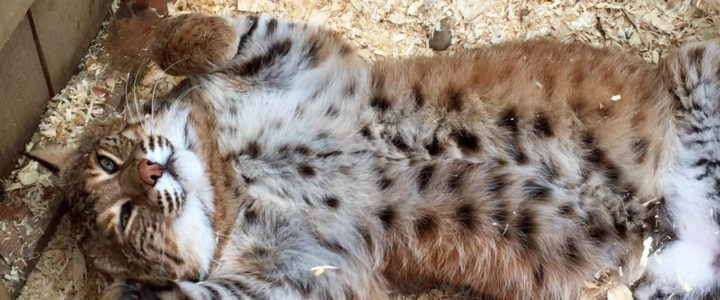

Meet the “fearsome” bobcat named Preston.
They say: Preston’s such a laid-back guy. Not much bothers him. Preston is one of several animal ambassadors who live at AFAS. “Preston loves the attention of having his picture taken almost as much as he loves his little playhouse.”
Visit: http://www.afasrehab.org/
EYE ON THE NEWS
FIGHT CLIMATE CHANGE – GO VEGAN!

THE MARCH FOR SCIENCE
As President Trump would like to cut billions from the EPA and National Institutes of Health in order to increase military spending, there was an outcry from scientists and their friends. It manifested in the “March for Science” in April and was held in cities throughout the world. In one article on CNN online http://www.cnn.com/2017/04/21/health/march-for-science-walkup-trnd/ a cancer researcher named Leslie Paul was featured. Her important words went beyond her work on cancer and focused on the animals. She said: “If there was ever a time that it was important to say, ‘You can’t do that to the EPA, you can’t disregard wildlife, you can’t censor science,’ it would be now.”
Another featured marcher was conservation scientist Rachel Golden Kroner who said, “If we do nothing, we face a crisis for biodiversity and people.”
We were impressed by the fact that so many of those in attendance focused on how the animals are being affected by human caused climate change.
One very important contingent of the March for Science was the Factory Farming Awareness Coalition – FFAC-Chicago – that produced this great poster: http://www.ffacoalition.org/

WISCONSIN DNR SCRUBS LANGUAGE TO continue to
BAFFLE and CONFUSE ABOUT CLIMATE CHANGE
Chris Jazewski, a Wildlife Watch member, sent an article from the Milwaukee Journal Sentinel by Lee Bergquist:
The article reported that the DNR recently scrubbed language from an agency web page on the Great Lakes that said humans and greenhouse gases are the main cause of climate change.
The DNR now says the subject is a matter of scientific debate. The department made the changes on 12/21, striking out whole sentences attributing global warming to human activities and rising levels of carbon dioxide.
Mr Bergquist said this; More broadly, the changes reflect how the administration of Republican Gov. Scott Walker has de-emphasized the subject since he took office in 2011.
The Governor can be contacted here: https://walker.wi.gov/contact-us
WHY BE VEGAN?
We urge our readers to move in the direction of veganism for many reasons. One article that we found to be excellent is written by Ashley Capps. It can be found here: http://freefromharm.org/why-vegan/
To get up close with some fortunate animals who’ve escaped one of the worst fates we can imagine, please visit a local farm sanctuary. Here in the Hudson Valley, NY, you’ll find two great ones: http://woodstocksanctuary.org/your-environment/ and https://casanctuary.org/
COWS HAVE FEELINGS
In spite of their dire situation, they are shown giving love to a little cat, and obviously, the feeling is mutual.

PROGRESSIVE ORTHODOX RABBIS CALL FOR A REDUCTION OF MEAT CONSUMPTION
Shmuly Yanklowitz
In April, 2017, a group of progressive orthodox rabbis from around the world called on the Jewish community to consider the moral and spiritual dangers associated with meat consumption. While they condemned factory farming, they also pointed to the fact that significant and unnatural pain is caused toward animals during their raising and slaughter for human consumption, which in turn contributes to health conditions. They asked for a reduction of meat intake and described it as a global concern.
Visit: http://forward.com/scribe/369525/orthodox-rabbis-warn-of-moral-and-spiritual-dangers-of-eating-meat/
Things To Know About

EXPAND YOUR KNOWLEDGE AND REDUCE YOUR FEAR OF COYOTES
Janet Kessler, a photographer and blogger, has documented and interpreted coyote life in San Francisco. In her website: www.coyoteyipps.com she advocates for tolerance and understanding of coyotes, and provides practical solutions for co-existing with this species.
Please visit her website to expand your knowledge of coyote behavior, reduce your fear, and keep your companion animals safe.

THE GINNY FUND:
By Anne Muller
I’ve known about the Ginny Fund for at least 20 years, and had the honor of meeting Ginny at a presentation by Philip Gonzalez. Philip was Ginny’s human companion who recognized her special talent. I remember how honored I felt when, during that packed lecture, Ginny meandered through the crowd, and then chose to sit by my side. She allowed me to curl the fur on her neck. The lecture was all about Ginny and her amazing work of rescuing special needs cats and dogs.
After Ginny’s sad passing in 2005, Philip carried on Ginny’s work to rescue stray cats and dogs from the streets. You can learn more about this wonderful organization by visiting:
http://www.lifewithdogs.tv/2016/05/the-ginny-fund-the-legacy-of-a-rescue-dog-who-paid-it-forward/
or her Facebook page

Anna Breytenbach communicates with wild animals:
Anna Breytenbach takes us on many journeys touching our hearts and souls, as well as touching the hearts and souls of the animals.
From sharks to baboons, her extraordinary communication with animals will leave you in awe.
Additionally, Ms. Breytenbach succeeds in communicating with our own species in order to engender compassion in us.
Please visit her website and watch her extraordinary super sense in action: http://www.animalspirit.org/ and watch her incredible videos on YouTube

CAARE
According to CAARE, the need for improved methods of drug development is essential. The FDA describes the current process, which is based largely on animal testing, as “complicated, time-consuming and costly.” It is also extremely inhumane.
Only 5 in 5,000 compounds that enter early testing make it to human clinical trials, and only 1 of those 5 may be safe and effective enough to reach the market.
To view the medical testing breakthroughs that replace the use of animals, please visit this website: http://www.caareusa.org/ Bob, please close the right justification
Let’s Go Wildlife Watching
LIVING IN NEW YORK CITY? LONGING TO CONNECT WITH NATURE? CONSIDER THE URBAN NATURALIST PROGRAM AT THE NEW YORK BOTANICAL GARDEN
https://www.nybg.org/learn/adult-education/urban-naturalist-certificate-program/
A quick look at the website summarizes the program this way:
This five-week program focuses on vascular and non-vascular plants, invertebrates and vertebrates of New York City’s uplands and coastal wetland ecosystems, emphasizing the critical conservation issues facing each locale. Classroom lectures and hands-on activities are complimented with classes in the field and working excursions in the Thain Family Forest, Bronx River, Central Park, and Pelham Bay Park, among other locations.
Chris Arenella, a friend and member of Wildlife Watch, told us about the program. She said, When I learned that the New York Botanical Garden was offering a new program called Urban Naturalist that teaches students how to become stewards of our urban environment, I signed up.
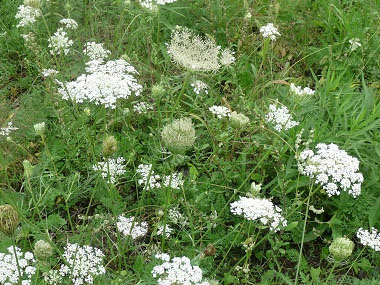
During my field trips, I have learned to see nature with a new intimacy. My eyes have begun to focus more clearly on the not-so-apparent. I’m now even more protective of our urban natural environment. I can now identify a flower I always knew as Queen Anne’s Lace as Daucus carota, or wild carrot.
If you’ve had an enjoyable wildlife watching experience that others will be able to have as well, please share it with us. Photos needed.
Please send to: wildwatch@verizon.net
Mitigation Banking by E. M. Fay
As American wetlands decreased in both size and number over the past few decades, falling prey to various forms of human encroachment, the federal government, spurred by the nascent environmental movement, made some efforts to ameliorate, or "mitigate," the situation. Mitigation banking was one tool that was developed for use in this cause, with what may be fairly called "mixed results."
In response to public concern about the degradation of our entire natural environment, the Nixon Administration implemented the Clean Air and Water Acts (1970, 1972) the Coastal Zone Management Act (1972), and the Endangered Species Act (1973). President Carter signed an Executive Order Protection of Wetlands (1977); and the first Pres. Bush announced a "No Net Loss" policy for wetlands, which was also endorsed by Pres. Clinton in his first term.
"NO NET LOSS"
The concept of "no net loss" was that anyone wanting to develop property in a protected wetland area would be obliged to "replace" the loss of that area by creating or restoring an equivalent wetland. Thus, it was thought, there would be "no net loss" of wetland acreage. This was considered to be an enlightened way to protect our fast-disappearing wetland habitats and their dependent animal species, as well. It also spawned the use of mitigation "banks" as a way of keeping track of these exchanges of land.
MITIGATION BANKING
Just as one keeps records of financial transactions in a bank, the creation of new wetlands as payment for the destruction of others is recorded in order to ensure that there is no net loss. Federal guidelines for the implementation of the Clinton Administration’s Wetland Plan defined the notion of mitigation banking as: "the process of preserving, enhancing, restoring, or creating habitat to compensate for unavoidable wetland impacts." It is preferred that this creation/restoration be accomplished prior to any building project, and the resultant new or restored wetland is expressed as a "credit" in the mitigation bank. Mitigation banks, then, provide a way for land developers to compensate for their destruction through currency "credits" of wetland creation, which pay for the "debits" of wetland destruction. Ostensibly, the developer would create or restore a viable wetland habitat of similar type and size to the area he is ruining. However, some developers understandably want to avoid taking on such a daunting task themselves. With mitigation banking, they can go to a land owner who has already created or restored a large wetland area, buy acreage in that property, and count it as a credit that makes up for their planned destruction.
Of course, creating a wetland from scratch is harder than restoring an ailing one. An on-site watershed is necessary; appropriate soils and vegetation may have to be imported; proper drainage is required. The developer who is acting as the banker might choose instead to enhance an existing wetland that just needs some improvement to meet the federal guidelines.
Virtually anyone can set up a mitigation bank. In some cases, local municipalities will establish a bank in order to protect their watershed needs; a Department of Transportation might set one up in order to compensate for their road-building projects; or a private entrepreneur could set up a bank simply for the purpose of buying and selling credits at a profit.
Before taking part in the banking process, a developer is supposed to try to avoid negative impact on the site in question; failing that, they must minimize the impact; and finally, they are to provide compensation for any remaining damage. While the first two steps in this sequence can be recognized as preferable to the third, unfortunately, the arrival of mitigation banking on the scene has encouraged many people to neglect efforts to preserve the natural site, seeing the way of compensation as a cheaper alternative. Adding to this betrayal of the spirit of wetland preservation is the fact that off-site mitigation is allowed. Where developers were originally required to restore or enhance the on-site wetland, now, through mitigation banking, they are allowed to compensate for their destruction of one site by creating another some place else.
Another feature of mitigation banking is that many small projects are typically consolidated into a large, contiguous creation area, believed to be more ecologically valuable than several isolated sites.
REGULATION / OVERSIGHT
Regulation of mitigation banks is clearly essential to make sure that compensation is properly made and eco-systems are preserved. The Army Corps of Engineers has the authority to issue permits for affected sites, and one might reasonably expect state departments of Ecology or Environmental Protection to monitor the continuing health of new sites. However, a NYS DEC official told me that sponsors are not legally forced to follow up on a restoration project. What sort of oversight is that? US Army Corps Engineer Dr. Robert Brumbaugh writes that "almost all [mitigation] banks established have been ad hoc arrangements between regulators and development entities." The impermanence of these arrangements do not inspire confidence. Although regulators are supposed to assess the comparability of the sacrificed wetland to the new one, Dr. Brumbaugh adds, "Owing to limitations in wetland functional assessment methodology, to date, in many cases, credits and debits have been measured simply in terms of acres." In other words, the quality and function of the wetland is often left out of the equation. By neglecting these two aspects, a newly created wetland that was meant to take the place of a built-over one, is likely to fail.

Mitigation banks in Florida.
The Army Corps itself has been criticized for poor handling of wetlands protection. Sen. Joseph Lieberman, in an August 2003 letter to Army Under Secretary Les Brownlee, wrote that he was "extremely troubled by assertions that the Corps of Engineers and the other federal regulatory agencies have failed to fulfill their statutory mandates, thereby endangering a valuable national resource..." (Quoted by Mike Salinero in Tampa Tribune.)
WHO BENEFITS FROM MITIGATION BANKING?
The benefits of banking for the landowner are obvious: land that was previously off limits can now be used, as long as land elsewhere is slapped into a supposedly suitable condition. Variations in land values being what they are, this may prove much cheaper for the developer, particularly if he is not conscientious about creating a perfect replica of the original site. Even the most well-intentioned can find this a forbiddingly difficult task, as each wetland is unique, with plant and animal species that might not thrive anywhere else. Not every patch of wet ground can be turned miraculously into a viable substitute.
The permitting process is more efficient with banking, as applicants no longer require both a development permit and a wetland permit. Regulatory agencies save time as there are fewer reviews needed: many smaller projects are consolidated into larger ones, as recommended by the banking program. And local officials - Town Boards, Planning Boards - are spared protests from environmentalists as citizens are assuaged by the belief that mitigation’s no-net-loss ideal is preserving our nation’s wild heritage.
THE DOWNSIDE
This seemingly happy solution to the problem of development versus nature has its critics. The Sierra Club does not support banking, noting that even "wetland biologists do not have the technical ability to create or restore all the functions of complex wetland systems."
Testifying before a Congressional Subcommittee on Water Resources and the Environment, National Wildlife Federation Wetland Specialist Julie Sibbing, opposed the American Wetlands Restoration Act. After enumerating the many benefits of wetlands, including flood-water retention, groundwater recharge, water quality improvement, and wildlife habitat, Sibbing noted that the no-net-loss policy does nothing to prevent the breakdown of remaining wetlands. "America’s wetlands are more vulnerable to destruction and degradation than at any time in the past 25 years." Sibbing cited several causes for this vulnerability, including "overly broad interpretations of the Clean Water Act loophole."
The challenge of re-creating a successful eco-system is considerable. "The idea that you can just go out and build another wetland is one of the myths that has been hardest to let go of," says Sibbing. "In general, our mitigation efforts have been dismal failures." (AP article, John Flesher, 12/23/03.) Additionally, the consolidation aspect of mitigation banking meant that the smaller, isolated wetlands were not really being replaced in kind. While a large, contiguous wetland sounds nice in theory, the loss of scattered areas could have unanticipated consequences: one suggested by Sibbing was altered flooding patterns, which affects human as well as animal populations.
The balance of water, appropriate soil types, and equivalent plant species is not always possible at sites that are distant from the original, now destroyed, wetland. A US Geological Survey Summary on Water Resources identified another potential problem: people might actually be encouraged to destroy natural wetlands if they are misled into thinking they can be easily replaced. The cheerful assumption of enhanced ecological value via mitigation banking is therefore rendered dubious.
Compensation through mitigation banking, originally intended as only the third leg of the preservation process, is becoming more prevalent. From 46 approved banks chartered nationwide in 1992, the industry had grown to nearly 300 by 2001. In Florida, alone, there are at this time 38 banks in existence. A financial success, perhaps, but to what effect on our natural treasures?
The impact of mitigation banking on wildlife is difficult to determine precisely, but logic may provide a reasonable interpretation. One likely result of the trading of wetland areas - credit here, debit someplace else - would be the disorientation and consequent dispersal of the traditional wild inhabitants of any given region and an eventual decrease in their number. We need only picture how we would react to having our neighborhood suddenly vanish. There would be no comfort in being told there is a "similar" habitat 20 miles away replete with residents who would not want to be displaced!
Just as animal species suffer from the man-made changes to their natural environments, so also do irreplaceable plant species disappear from our national landscape. And the failure rate of man-made wetlands is shocking. Consider as just one example, in the state of Michigan only 22 percent of authorized projects were deemed successful judging by natural functions such as water purification and wildlife habitat. Yet, mitigation banking is still a common and government-approved fact of life in 34 states.
Whenever economic and natural-resources considerations collide, you may generally depend upon the former to triumph at the expense of the latter. When regulatory agencies seem to collude with private groups, it is very dispiriting. For example, the St. John’s River Water Management District, which covers a huge part of Northeast Florida, is currently considering the request of a Baptist Church that wants to build a bridge over the headwaters of the Tomoka River, thus filling in a pristine wetlands area. The church proposes to buy land from a mitigation bank some miles away, as payment for their construction, which, environmentally-concerned opponents of the project contend, will naturally do nothing to preserve the Tomoka River itself. At issue here are the rather suspect standards of the agency. As the SJRWMD has said that the project meets their requirements, one must ask why those requirements are so lenient that they would permit the blocking of an important tributary to the Tomoka. As local citizen, Capt. Eric West, put it, "The land bank doesn’t make new wetlands, it just keeps profits coming in for those who own them now." He suggests rewriting the rules of SJRWMD to make it harder for people to take advantage of the present, slipshod situation that easily allows ruination of wetlands.
A Florida environmental attorney, Lesley Blackner, doubts the wisdom of elected officials, too many of whom, she says, "define ‘public interest’ as keeping the development industry happy." She advocates that people have the power to decide on land use changes in their own communities. Blackner maintains that the mitigation system is a kind of "shell game," sold to the public as way of saving our wetlands, but in reality merely a sham, causing the destruction of healthy habitats and setting up false substitutes.
WHAT CAN WE DO?
An amendment to the Federal Water Pollution Control Act, a bill which deals with the chartering of mitigation banks, was introduced in June of 2003, and is still pending. H. R. 2531 IH may be reintroduced in the next Congress, commencing in January. If we wish to have any influence on the survival of our inherited wetlands, and protect the lives of their many dependents, we must call and write to our Representatives now, expressly stating our concerns regarding the use of mitigation banking. We can keep informed about local plans for wetland development, and attend Town and Planning Board meetings, speaking up and asking for details on such plans; and requiring that any mitigation bank providers, whether commercial or municipal, be monitored by the relevant agency. And don’t assume that regulatory agencies, however much they might speak about being "good stewards of the environment," are doing what is best for wildlife and wetlands. Their standards should be reviewed before they give out any more permits for destruction. Only by consistent and vociferous action can we hope to ensure the survival and maximum health of our precious wetlands and their residents.
References used for this article:
US House of Representatives website - Sept. 12, 2001 Hearing on HR 1474 Before Subcommittee on Water Resources and the Environment; Statement of Julie M. Sibbing of NWF
US Geological Survey, Water-Supply Paper #2425
US Environmental Protection Agency, Laws, Regulations, Guidance, and Scientific Documents: "Wetlands Mitigation Banking"
Florida Dept. Of Environmental Protection website
University of Florida IFAS, Handbook of Florida Water Regulation
Department of the Army, Federal Register: November 28, 1995 (Volume 60, #228)
US Army Corps of Engineers, Jacksonville, Fla. District, Public Notice web page: "Mitigation Banking"
Washington State Department of Ecology, Access Washington: "Wetlands Mitigation Banking"
Univ. of Oregon, School of Law, Ocean and Coastal Law Memo, Issue 36, October 1990
Great Lakes Directory website, Great Lakes Article: "Creating New Wetlands Not So Easy to Do," by John Flesher of Assoc. Press
National Wildlife Federation website, Testimony on Mitigation Banking before House Sub-Committee on Water Resources and the Environment, Sept. 12, 2001
Sierra Club website, "Clean Water and Wetlands: Mitigation Banking Guidelines"
Alachua Post (online newspaper) - Ad Hoc Committee, 4/26/02
Mike Salinero, Tampa Tribune article, Aug. 29, 2004, "Feds Probe on Wetlands Permits"
Statement of Lesley Blackner in Support of Florida’s Hometown Democracy Amendment
E.M. FAY is a freelance writer with a bent for environmental and animal-rights causes, as well as politics. She has worked as a stringer for the Daily Freeman, a leading newspaper in Kingston, NY. She presently has an article about whales' and dolphins' suicides caused by man in Natural Life, a Canadian magazine.
Wildlife Watching Programs National Shift Pales Hunting Economy by Peter Muller
In the past decade, a dramatic shift has taken place with respect to how Americans engage in the recreational enjoyment of wildlife. State agencies have maintained that their mission statement requires them to provide for the recreational enjoyment of wildlife – and that mandates them to provide hunting opportunities. Traditionally, "recreational enjoyment of wildlife" has meant hunting, and that was the interpretation given it under law.
The economic and moral shift that has occurred has given new meaning to the term "recreational enjoyment of wildlife." It requires a new interpretation of such legal mandates and a re-examination of the commercial opportunities that are provided by the recreational enjoyment of wildlife.
The shift has seen wildlife watching as a recreational activity far outstrip hunting in the number of participants, population percentages of participants, and in the amount of money spent on the activity.
We would expect the government agencies that are charged with providing opportunities for the recreational enjoyment of wildlife to develop programs to accommodate this numerically larger population whose purchases far exceed those of hunters. But, perhaps even more importantly, we would expect alert businesses to shift their attention from accommodating hunters to capturing this exciting new market of wildlife watching – especially since the two markets often make irreconcilable demands on resources. It won’t be long before the wildlife watching programs will come into conflict with the more poorly funded hunter programs that cater to only a fraction of the population. Both programs in most places can not be accommodated simultaneously.
Wildlife watching trends are significant nationwide but they are especially noteworthy in the States of New York, Florida and California.
All statistics cited below are all from the "2001 National Survey of Fishing, Hunting and Wildlife-Associated Recreation." This survey is published every 5 years by the Fish and Wildlife Service of U.S. Department of the Interior and the U.S. Department of Commerce.
(When we’re using population figures in this discussion we are using residents age 16 and over, they are not included in these numbers.)
The basic numbers nationwide:
HUNTERS:
- there were 13 million hunters in the United States in 2001
- they constituted 6.12% or the population
- they spent a $20.6 billion in hunting related expenditures
WILDLIFE WATCHING:
- there were 66.1 million participants in wildlife-watching in the United States in 2001
- they constituted 31.14% of the population
- they spent a total of $38.4 billion in wildlife-watching related expenditures
For New York State these numbers are:
HUNTERS:
- there were 642,000 hunters in New York State in 2001
- that constitutes 4.52% of the population (even though some were from out of state)
- they spent a total of $ 822.2 million in hunting related expenditures
WILDLIFE WATCHING:
- there were 3.887 million participants in wildlife-watching in New York State in 2001
- that is the equivalent of 27.37% of the population (even though some were from out of state)
- they spent a total of $1.407 billion in wildlife-watching related expenditures
Certainly the nationwide expenditure of $38.4 billion for wildlife-watching related activity makes wildlife watching a major industry. If wildlife-watching were a business it would be in the same league in terms of annual sales as Pfizer ($40.36 billion), Time-Warner (38.08 billion), or Prudential Insurance ($38.22 billion). Wildlife watching is a major economic player which is currently under-reported and underrated. It is a veritable business boom waiting to be discovered.
Inn keepers and resort owners should take note that a considerable portion of the expenditures are for food and lodging!
Nationwide hunters annually spend $2.45 billion on food (a lot of beer) and lodging in connection with hunting related activities; Wildlife watchers, however, spend $4.82 billion a year on food (with more diverse drinks) and lodging in connection wildlife watching related activities. Consider that wildlife watching is not yet institutionalized!
Each year in New York State hunters annually spend $82.4 million on food and lodging in connection with hunting related activities. Yet, wildlife-watchers annually spend $124.4 million on food and lodging in connection with wildlife-watching related activities in New York State.
The report shows that wildlife watchers are better educated, more affluent and travel with family members more than hunters.
USFWS statistics cited in the 2001 National Survey of Fishing, Hunting and Wildlife-Associated Recreation:
On average, hunters have no education beyond high-school; the median wildlife-watcher has 1 to 3 years of college. Seven percent of people with a family income of over $100,000 per year hunt, but 40% of those with a family income exceeding $100,000 engaged in wildlife watching. While only 9% of hunters are female – about 50% of wildlife watchers are female (54% of state-residents and 48% of out of state wildlife watchers are female).
New York State ranks third in the country among states in spending on watching wildlife. The three states receiving the greatest expenditure by wildlife watchers are:
1. California -- $2,580,875,000
2. Florida -- $1,575,481,000
3. New York -- $1,407,193,000
It’s important to realize that this has happened with little or no pro-active effort on the part of the inn-keepers and resort owners to attract wildlife watchers. On the contrary, by permitting and even encouraging hunters to come into areas when wildlife watching could be at its peak -- in the fall and during bird-migrations -- wildlife watchers are being sent a message to stay away.
We propose a pro-active campaign for communities and businesses that have a natural wildlife resource to promote wildlife watching opportunities in their areas.
Wildlife watchers are not a destructive force, they pose no risk to others or surrounding houses. They prefer to be as unobtrusive as possible. If resorts set up platforms, tree stands, and blinds, it would bring many eco-tourists to remote areas such as the Catskills region of New York State where the local economy has been devastated since the 1960s. Certainly, promoting wildlife watching as a tourist attraction is sociologically as well as economically preferable to introducing casinos.


Both photos from Everglades National Park
The conversion of some of the old resorts to accommodate wildlife watchers can be achieved for a relatively modest investment. It would also benefit the resort to invest in the construction of living platforms over water, for example chickees http://www.nps.gov/ever/visit/sitetype.htm , and boardwalks over wetland areas, as is currently done in the Everglades in Flamingo, Florida. This should all be done in consultation with experts. Wildlife watching will provide lucrative financial returns. This is a major industrial development waiting to happen. It is a win-win-win situation for the resort-operators, the wildlife watchers – and the wildlife.
Please contact us at wildwatch@verizon.net to become involved in this multi-faceted thrust to a brighter future for all.

Hunter websites, like Cabelas, offer products that can be used by wildlife watchers to enhance their experience. Should wildlife management agencies begin to focus on watching, you can imagine the increase in business for products such as the one to the left that sells for only $13.
The catalog describes it this way: "The comfortable behind-the-ear Woodland Whisper has five settings for up to 98db amplification with a decibel-limiting feature that won't amplify loud noises, so you can hear the faintest sounds in the woods."
AUDUBON
In October, Audubon released its first The State of the Birds report. They called the decline of bird populations "disturbing" and "abnormal." Audubon wants improved grassland, forest, and wetland protection; they want stronger pollution controls, backyard habitat programs, and private landowner programs. They cite the following statistics: 69 million Americans say they are birdwatchers. They contribute 32 billion in retail sales, 85 billion in overall economic output, 13 billion in state and federal taxes, and create almost 900,000 jobs [and that’s without trying!]
WASHINGTON SMELLS THE ROSES
In January, 2003, the state of Washington requested legislation that would "establish a watchable wildlife decal. They wrote "Nature-related tourism is the fastest growing segment of the travel industry with wildlife viewing rated as the number-one outdoor activity in the US. Washington ranks seventh nationally in wildlife-related expenditures, with more than $980 mission being spent on wildlife viewing activities. Most of these opportunities exist in rural communities and provide a major economic stimulus

WATCHING THE CROWS OF AUBURN, NY
Rita Sarnacola of CROW (Citizens Respectful of Wildlife) in Auburn, NY has been working on ways to wake up the town to the economic potential of wildlife watching. A bar has been having "crow shoots." Rita and Wildlife Watch would like to see Auburn, NY become the crow capital of the country. Wildlife Watch volunteers will soon be doing a presentation in Auburn to discuss the potential of wildlife watching and setting up for viewing these sociable, intelligent and playful birds. We will emphasize the economic potential that crow watching will have on Auburn.
www.crows.net/help.html - Have some cornchips!