MY FREE TEN-DAY STAY AT HIPPO HAVEN IN ZIMBABWE

BY SHERRY REISCH

Painted Dog

Probably like you, I had never won a raffle before, but winning a trip to the Turgwe River Hippo Trust in Zimbabwe, Hippo Haven, was a dream come true.  I heard about the Turgwe hippos and the English lady who founded it, Karen Paolillo, through a friend and fellow animal activist/advocate.  I had donated funds for a food drive needed to feed the hippos during a drought.  Coincidentally, other free wild animals were saved as well. Karen truly saved many lives that year.  As a result of my donation, I became eligible to enter her raffle for a free ten-evening stay at the Trust.

On the drive out to Hippo Haven, I saw kopis that are magnificent African mountains made  from what looks like stone sculptures. The bush appearance varies depending on where you are and, maybe, what animals inhabit that area.  I saw wild painted dogs on this part of the trip, not quite at the conservatory yet.  They are breathtakingly beautiful.  And no, they did not bark at us in the truck.  I also saw giraffe. How magnificent and sweet and gentle they are.  Wildebeest, kudu, impala, a giant kingfisher bird and a hammercrop bird all crossed my path that first exciting day.

Kuchek

The next morning we hiked down to the Turgwe River, where I met five hippos: Surprise (“adopted” by my friend), Kuchek the bull, George (baby), his mom, Tacha, and Bonbon. I “adopted” Kuchek and Tacha!  Seeing the hippos in the Turgwe River was life affirming. To see them in person was to see and hear their souls. And their souls are pure. They make sounds that sound like laughter.  They enjoy the water, and also need it to stay hydrated and cool.  To see them is also to see how big they are!  It is fantastic to see them with their gaping mouths!

Each morning was a walking safari and each afternoon was a jeep safari.  Karen is very wise and knowledgeable in tracking and in all things animal.  She was the first-ever female guide in Zimbabwe!

Squiggles the mongoose with Torti the cat

I met their resident mongoose, Squiggles, who is now four years old.  Squiggles was found alone as a newborn and was rescued by Karen and Jean Roger, her husband.  I got to know the neighboring baboons and vervet monkeys, whom I also got to feed! At night I would watch as a genet named Jenny would come by for her late-night dinner provided by Karen.

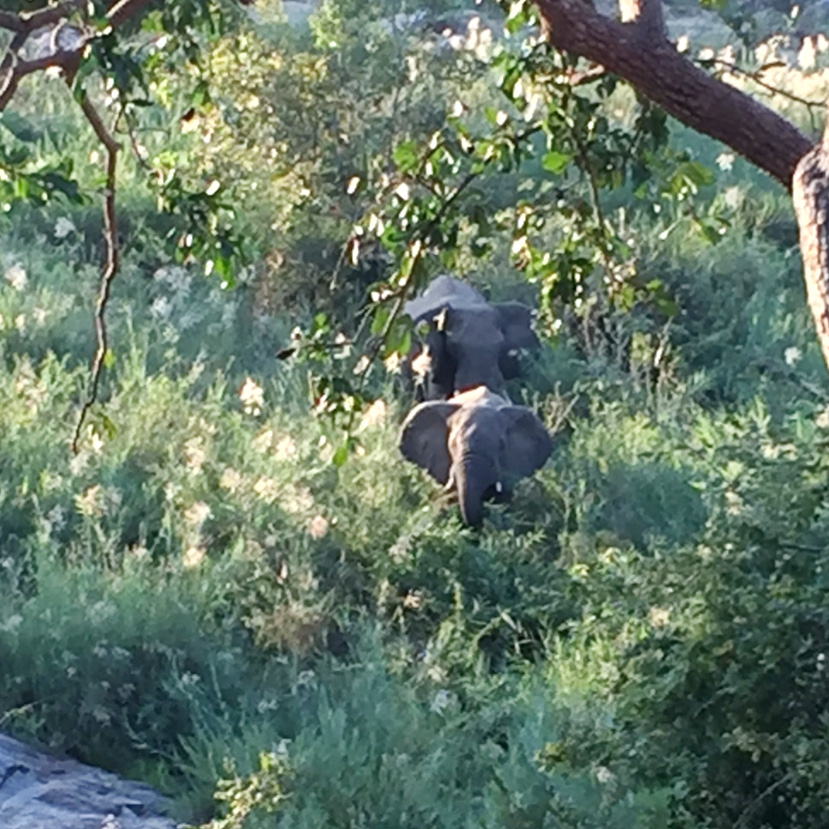
During our afternoon and morning safaris I also saw crocodiles, buffalo, zebra, black eye eagle nest, and many species of birds.  It is amazing how the crocodiles and the hippos live peacefully together in the river.  On one of our afternoon safaris we came across a family of about twenty elephants.  It was mesmerizing to watch them walk slowly and deliberately and eat.  We watched intently as one elephant was taking a sand bath!

Sherry holding up the Baobab Tree

There is a tree named the elephant palm tree.  Baboons eat the outer part of the fruit.  The elephants eat the rest.  The only way this tree germinates is when the elephant poops out the fruit.  Hence, the name!

I also saw the largest baobab tree in Southern Africa. It is twenty five hundred years old.  I think this baobab tree is the one used in the Harry Potter series.

Sadly, there are hunting areas in this conservancy.  No hunting is allowed on the Turgwe River Trust land. Karen explained to me that the government sets quotas on how many of each species of animal may be killed. Then each hunting area must communicate with one another to ensure compliance with the quotas.

Elephants in the mist

Jenny the Genet

Also, there is unfortunately a problem of poaching.  Turgwe River Trust and other groups search for illegal snares and poachers, and hire game scouts.  It is a sad reality in the bush.

Safari Club International is the largest group of hunters and they meet each year on the west coast of the US.  Americans make up the largest group of trophy hunters! We hope changes will be made in the future. 

Seeing animals living freely and going about their daily lives, gave me hope of a better world for all of them.

To visit the Turgwe Hippo Trust, Hippo Haven, you can make your donation today to adopt a hippo and watch for the raffle that usually takes place in November of each year.  Or, just make a reservation!  It is truly a magical and life affirming experience.

Sherry Reisch is the lucky and proud companion and guardian of Elly, a Shepherd-Doberman mix.

THE TRUE BLUE BLOODS OF THE OCEANS: HORSESHOE CRABS

Orchard Beach Pelham Bay Park, Bronx, NY.  Photo by Chris Arenella

Horseshoe crabs are perhaps the most misunderstood and under-appreciated creatures on earth. Until a recent study and field trip, I, too, knew nothing about the empty, large brown shells occasionally found on beaches in New York and New Jersey.  I learned that those were the shells of the unfortunate ones who found themselves on their backs and couldn’t turn back over.  When that happens, they are vulnerable to seagulls who are always nearby waiting.

They predate the dinosaur by approximately 200 million years, making them 450 million years old. According to Wikipedia: Horseshoe crabs are marine arthropods of the family Limulidae and order Xiphosura or Xiphosurida. (It’s not exactly a cozy description.)

Horseshoe crabs live at the bottom of shallow ocean waters, they swim upside down, and come ashore on beaches to romantically mate during the full moon from May to July. The females are larger than the males. Males choose their mates by attaching themselves to the backs of the females.  I have seen 3 males attached to one female (see my photo above). The female lays her eggs in the sand, and they are fertilized by one or many males and then hatch about two weeks later. 

Horseshoe crabs do not have hemoglobin in their blood, but instead use hemocyanin to carry oxygen. Because of the copper present in hemocyanin, their blood is blue.  Medical science has discovered that their blood contains amebocytes, so it is used for the detection of bacterial infection in medical applications.  Horseshoe crabs are actually protected for that reason.

They are harvested, their blood is collected, and afterwards they are released back into the ocean. As a result of that tramua, their mortality rate is estimated to be as high as 30%. 

As with any animal, Wildlife Watch would like to see safer, more reliable sources of amebocytes that would not necessitate the use of any living being.  The reasons given by a major distributor of horseshoe crab blood is that getting approval for synthetic alternatives is costly and time consuming.  Yet, we should be moving in that direction.  As horseshoe crabs have been used by anglers as bait, there are many other factors that could impact their population.  Further, little is known about their place in the ecological realm.

Horseshoe crabs live at the bottom of shallow ocean waters, they swim upside down, and come ashore on beaches to romantically mate during the full moon from May to July. The females are larger than the males. Males choose their mates by attaching themselves to the backs of the females.  I have seen 3 males attached to one female (see my photo above). The female lays her eggs in the sand, and they are fertilized by one or many males and then hatch about two weeks later. 

Horseshoe crabs do not have hemoglobin in their blood, but instead use hemocyanin to carry oxygen. Because of the copper present in hemocyanin, their blood is blue.  Medical science has discovered that their blood contains amebocytes, so it is used for the detection of bacterial infection in medical applications.  Horseshoe crabs are actually protected for that reason.

In my opinion, mankind owes a great debt of graditude to these slow moving and gentle crabs who don’t even bite.  For that reason, and the fact that I find them endearing, I have taken on the stewardship of the horseshoe crab. I have made many trips to the beach to monitor them, and have contacted the NYC Parks Department to enlist their help with signs. If you see a horseshoe crab on his or her back, just flip her over and gently nudge her back into the water.  You’ll have saved a precious life.  If you’d like to help them, please contact me via Wildlife Watch: wildwatch@verizon.net.

Chris Arenella became a horseshoe crab steward during her Urban Naturalist program at the New York Botanical Garden.

XANDA, SON OF CECIL, KILLED BY HUNTER IN ZIMBABWE

Summarized by M.R.G.

Xanda with one of his lionesses

Xanda with his pride.

It’s hard to forget the tragic death of Cecil the lion who in 2015 was shot with a bow and arrow by  a Minnesota dentist, Dr. Walter James Palmer, a trophy hunter. Doubly shocking is that one of Cecil’s sons, Xanda, met his untimely and tragic death by a trophy hunter this past July.

Oxford University’s Wildlife Conservation Research Unit (WildCru), said that Xanda’s family consisted of three lionesses and eight cubs, all dependent on him. Dr. Andrew Loveridge of WildCru rates the chances of the cubs’ survival without Xanda at only 50%.

The exact circumstances of Xanda’s death are unknown, but the team has reported in the past that a zebra is shot first and used as bait to lure lions into an area where it’s legal to kill them.

Dr. Loveridge captures the feeling of loss, frustration and disappointed bafflement in this statement: I’ve handled that lion, felt the size of paws and seen him interact with his pride and cubs. I cannot understand why another person would look at that wonderful animal and think they couldn’t be happy until they had killed it and put parts of its body on their wall.

Please see the full article What really happened to Xanda, the son of Cecil the lion? written by Joe Shute for The Telegraph here.

WILDLIFE WATCH HELPS DURING HURRICANE HARVEY

After seeing the devastating photos of people struggling to survive, we started to call the Houston area wildlife rehabilitators on our list. Texas is a state from which we receive many wildlife calls.  As people were dealing with the high winds and rising waters, the only one we were able to reach was Pam Jordan.

Her house in Houston was flooded, and she said she was in the process of moving her wildlife charges into another house outside of the flood zone. Due to technical difficulties, we were unable to get the photographs she sent to us in time, so we are adding an additional page online. 

TWO ORPHANED FAWNS BROUGHT A PA NEIGHBORHOOD TOGETHER

By Lynn Leming

In early July, while driving home from work on I83, I saw a sight that always breaks my heart – a dead dear completely obliterated on the highway.  As I exited, I saw another disturbing scene, there were two very young fawns!  Putting two and two together, I realized that they were the fawns of the unfortunate dead doe I had seen on the road.  These fawns didn’t know where to go without Mom, and this caused even greater concern.   Both fawns were in a little patch of grass just a few feet from the interstate.  I immediately pulled over trying to assess what if anything I could do to help them.  In fact, I cried!  I knew that as small as they were, they would not survive.  I knew for sure that if I went near them I could push them into traffic, so I went home to talk to anyone in my neighborhood who would listen.  Thankfully, they did listen, and listen some more!  Some told me there was nothing that I could or should do.  Others felt my pain and listened.  We started to brainstorm what steps could be taken.  We would take it one day at a time.  We knew that we would need to feed them and lure them closer to the nearby woods.  Then, in enters the phone call that guided me to take immediate action – Anne at Wildlife Watch!  She kindly listened and encouraged me to move forward with a simple plan.  We talked about moving them into the woods by offering them a mix of goat milk and baby rice cereal.  Off I went to Walmart to buy goat milk and baby rice cereal.  The little ones almost immediately moved into the woods for their evening and early morning feedings, but disturbingly they daily went back to that grassy area where danger awaited should they step into the traffic.

This could have been the end of the story, but of course it wasn’t!!  There were many ups and downs all through the summer as our neighborhood continued to watch them grow!  Daily, we fed them formula, fruits, sweet corn, and clover.  We placed signs that were made and donated by a local hardware store at the entrance and exit of the Interstate, and talked about them daily.

Many neighbors saw them in their backyards grazing, and I continued to feed them in my new friend’s  backyard at the edge of the woods. I talk to them almost daily and they acknowledge my presence.  We have all loved them as we have watched them grow and flourish.

They have grown now and have joined a doe and her twins and travel in the neighborhood together. Do we worry about them? Of course we do, but we have built friendships based on the neighborhood’s love for two fawns and hope and pray for their happy and safe adulthood!

VEGANISM MADE EASY

Dr. Will and Madeleine Tuttle are doing great work to spread the good word about veganism.

We urge you to watch a series of videos recently made by Madeleine that will show you not only how to make popular veggies in exciting innovative ways, but will show you kitchen equipment you didn’t know existed!

Madeleine grinds her own flour in a simple machine that allows her to use organic beans, lentils, rice, or any grain to make crusts, batters, soups, etc.  The best part is that her kitchen stays spotless during and after making amazing pies, such as onion pie!  Yes, believe it.

You can see the videos here.  You can also find them on YouTube by entering Madeleine’s Intuitive Kitchen.  Yum.Yum.

Be sure to get on Dr. Will Tuttle’s email list to learn more about his inspiring international work to spread the word about veganism.  You can email him at admin@worldpeacediet.com

If you aren’t already a follower, please read WORLD PEACE DIET. You can see more about it here.

PRESIDENT TSAI RESPONDS TO A LETTER FROM WILDLIFE WATCH MEMBER

Upon reading our last issue of the Wildlife Watch Binocular in which we lauded President Tsai of Taiwan for her courageous advocacy of animal protection, Marilyn Evanson, a longtime member of Wildlife Watch, wrote to thank her.

The President’s office sent back the following:


Dear Ms. Evenson:

This is to acknowledge receipt of your July 12, 2017 email to thank President Tsai and this government amending the Animal Protection Act, which makes animal cruelty a more severe crime.  We appreciate your encouragement.  It has been this government’s set policy to raise public awareness of animal welfare and the importance to protect animals from cruelty and abuse.  We understand there remains room for improvement, and will make an all-out effort to fulfill the tasks ahead.

Sincerely,

Office of the President

Let’s Go Wildlife Watching

NO HUNTING ALLOWED ON THE CHANNEL ISLANDS CONTROLLED BY THE NATIONAL PARK SERVICE

You will be able to enjoy your wildlife watching experience on these Islands knowing that in the fall wild animals will NOT be killed by hunters.

The park encompasses five islands: Anacapa, Santa Cruz, San Miguel, Santa Barbara, and Santa Rosa. The islands are in the Pacific Ocean off of southern California.  The promotional literature lists the various activities a visitor can have, such as hiking, camping, snorkeling, kayaking, birdwatching, photographing, whale watching, or just relaxing to the soothing sounds of the natural world!

A letter from the Superintendent of the National Park Service is printed in part below:

If you visit the park, you will be one of a very select group. Few people actually see this park because it is not easy to get to--you can’t drive to the islands. A short but exciting ocean voyage or a commercial flight in a small airplane is required. The park is one of the least visited of all of America’s national parks. The relatively light visitation enhances the islands’ feeling of solitude and assists in the protection of fragile resources. In establishing the park, Congress recognized the value of solitude by allowing for low intensity, limited entry visitation. So a visit to this national park will always provide a marked contrast to the bustle of southern California most people experience. It will always be a place where you can step back in time and experience coastal southern California the way it once was.

If you have visited these Islands, we’d love to know about your personal experience.

A blue whale, the largest mammal on Earth, can be seen there.

Carrot Rescues Long Lost Diamond Ring

Summarized by M.R.G.

Thirteen years ago, Mary Grams of Alberta Canada lost a gold and diamond ring while working in her garden. For all those years she kept it a secret from everyone but her son.  This August, Mary’s daughter-in-law was picking carrots to make for supper and noticed that a carrot had grown through a ring! Mary’s son knew it had to be his mother’s that was lost over a decade before.

Amazingly, this isn’t the first time someone pulled up some karats along with their carrots.

Read the full story here. 

EYE ON THE NEWS

Researchers Provide New Insights into Lyme Disease Solutions

Summarized by M.R.G.

According to an article written by Joe Lipovich of the CT Patch, Tim R. Hofmeester, a graduate student at the Netherlands' Wageningen University, led a recently published study that exposes new insights into the spread of Lyme disease, in which the red fox plays a vital role. Ticks that carry Lyme disease live on prey animals such as mice. With a decrease in predators such as foxes, prey populations increase and the ticks with them. According to the study, an increase in predators doesn’t actually decrease the abundance of prey, but rather causes the prey to engage in more “refuging behavior”, thus staying out of the way of ticks. There is research that suggests further that human interactions are driving up tick populations. For instance, rising temperatures and premature springs caused by climate change allow ticks to be active much earlier in the season. Therefore, being more aware of how we as human impact the environment is important to controlling the spread of tick borne illnesses. Working together with the natural order is one solution ready for the taking.

To view the entire article, click here.


GOOD NEWS FOR ANIMALS:

Animal protectors in Vietnam, a center for bear bile farming, arranged for 1000 bears who were living in painful and squalid conditions to be relocated. Legislation was passed so that within ten years (a loooong time for the bears) bear bile farming will not be allowed at all.
However, enforcement is weak and places to care for the rescued bears need to be found or set up.
To learn more about this horrific business, see this article by Kyle Swenson in the Washington Post:

To become involved with an organization that is helping the bears, visit: www.animalsasia.org

Taffy Williams of NY4whales sent the following good news:

This summer, Mexico City voted to ban dolphin shows.

AND…France has banned the captive breeding of dolphins and orcas. Visit NY4whales.org

IN MEMORY OF HOPE RYDEN BY Anne Muller

Jojo and John

Many of our readers know that Hope wrote over 24 books about the wild animals she came to know by spending years in solitude in their environment. Her astute observations and brilliant writing gave readers a different view of wild animals they either reviled or hadn’t heard of. 

But I’d like to tell our readers something personal.  It’s about Hope’s love for her last dog, Jojo. When Pete Muller and I met Hope in her apartment in New York City, she and John, her husband, had just adopted a large and energetic dog they named Jojo. Jojo gave so much joy to Hope during the time that they were together.  Hope especially loved telling the story about how he discovered a jar of peanut butter on the kitchen counter, cleverly knocked it to the kitchen floor, more cleverly managed to remove the lid, and most cleverly got every bit of peanut butter into his mouth.  

When we learned that Hope was no longer living in her apartment due to ill health, we were also concerned about Jojo and needed to find out what happened to him. Jojo, we had heard was taken by a family member temporarily to another state.  After weeks of trying to get more information, I was able to reach John who was living at their house upstate NY.  It was good to hear John’s voice - could he tell me what happened to Jojo?  “Yes, he’s standing right here next to me!”  I burst out laughing from relief!   That led to a delightful visit where I took the photo. 

Jojo had some age on him from the lean, spunky guy I remembered who loved racing back and forth along the hallway of his NYC apartment building.  He loved jumping on everyone who was brave enough to walk toward him (or back away from him), almost knocking them over - all to Hope’s delight! Jojo was still excited to have company, but after the initial surprise wore off, and perhaps as he recalled our visit to the apartment in NYC, I could tell from his far-away look that Hope was still deep in his heart, and I know he is in hers.  When I last talked to Hope, she certainly remembered Jojo, and had fun recounting memories of his antics.

A couple of years before ill health struck, Hope told me she was writing a new book.  It was to be about her life as it intertwined with the various dogs who had been a part of her history from childhood to the present time.  Each chapter would be about a different dog and her life during the time they were together.  I’m sure many of us who’ve lived long enough to have had successive dogs in our lives can relate to that way of organizing who we were and when.

Losing Hope Ryden is calamitous for the wild animals she loved so deeply, and whose lives she so intimately understood from her years with them in the wildAs a compassionate observer of their individuality, Hope was able to communicate their personhood even to people who didn’t agree that animals had any.  She was more than a writer and photographer, Hope was an activist who spoke out for wild animals who were hunted, trapped, and subjected to other types of cruelty. Her book, God’s Dog, a Celebration of the North American Coyote is a classic that rightfully transforms the demonized coyote (by game agencies, hunters, and Wildlife Services of the USDA) into God’s dog who has a purpose of his or her own, and, more importantly, a soul.

Hpe Ryden

Hope will be greatly missed!

Morgan’s Cat Café: Red Hook’s Own Cat Café and Rescue By M. Guercio

Nestled in at 35 West Market Street in Red Hook, NY is the cutest café you’ll ever find yourself in. Morgan’s Cat Café doubles as a vegan café, serving up delicious comfort food, and a shelter and adoption center for cats. As you walk in, a small and bright vestibule contains signs directing you as to how you can spend some quality time with the lounging cats in the free-roaming enclosure. The enclosure being mostly windowed, you can see all of the cats playing or relaxing as you walk from the vestibule into the café proper. Along with scrumptious food, there are a number of cute and quirky kitty treats and trinkets, literature, and adorable cat-themed cupcakes and cookies.

Executive Director Bobbi Jo has been rescuing animals for about 24 years. Her idea for the cat café started as a desire to open a vegan café and also as a legacy project for her daughter Morgan, who the café is named after, due to a serious medical issue that Bobbi Jo faced in 2015. Bobbi Jo wanted to provide people with a new and better way to interact with adoptable cats in a low  stress environment. Thus, Morgan’s Cat Café was started in July 2016 and has since rescued approximately 65 cats. The operation Bobbi Jo has is relatively small, but every cat counts. They focus heavily on the quality of care each individual cat receives and the smaller size allows for excellent monitoring of each cat that comes through their doors and out to their forever homes. The café is a non-profit organization and is run completely by volunteers. Morgan’s cat café is partnered with a number of rescue organizations, many of which are in New York City, and are where a number of their rescues come from.

Two rescues in particular had our attention that day: a pair of grey striped tabby kittens. These kittens were part of a litter of five that, just hours old, were left in a dumpster behind Taconic Farms Labs of Germantown NY. The kittens were placed inside of a bag with dead mice and rats, presumably, from the lab that breeds rodents for use in other laboratories. Bobbi Jo got a call from an employee of Taconic Farms telling her about the kittens in the dumpster and, with her help, all five were nursed back to health. Bobbi Jo and her daughter Morgan bottle fed the kittens but, eventually, another cat stepped up and became a foster mom. This cat even started producing milk for the kittens! The two kittens left at the café are the only two of the litter that have yet to be adopted, but hopefully that will soon change.

Bobbi Jo is doing a great job living off a wonderful motto she mentioned to me, which is her desire to “never profit from the slaughter of an animal”. Her next goal is to open a cat wine bar upstairs from Morgan’s Cat Café, and also try her hand at a vegan food truck. Keep an eye out for such business ventures of Bobbi Jo’s and, of course, try to head over to Morgan’s Cat Café in Red Hook, NY. Maybe you’ll even meet the newest member of your family.