

Yellowstone National Park, WY
by Joe Anderson
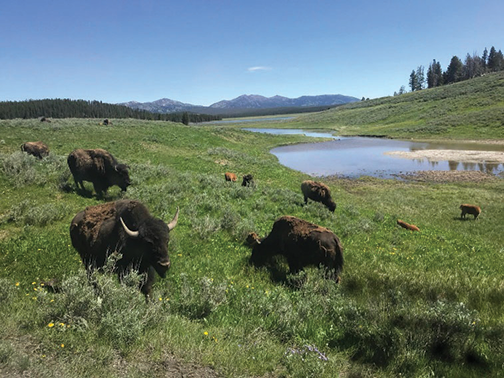
Yellowstone, a hotspot of the US park system, is known for sitting above a huge caldera that creates its famous geysers, hot springs, and bubbling sulfur pools. It is also a tourist hotspot as it draws people in from all over the world for a variety of reasons. Along with the mesmerizing volcanic activity, stunning landscapes, and world-class hiking, Yellowstone is one of the best places in the country to experience wildlife first-hand.
On my visit to the park in 2022, I had some up-close encounters with animals that I was seeing for the first time. Generally I am very careful to keep a safe distance from all wildlife but I did not have the opportunity to move away when I awoke to the shadow of an elk on the side of my tent. Despite large antlers, these majestic creatures are not aggressive and can be seen easily in Yellowstone’s fields and woods.
Later that morning an American Bison grazed peacefully a few hundred yards away from our campsite. These quintessential American animals were nearly driven to extinction by hunting in the late 1800s. They can now be seen in large herds within the park and are best viewed from the protection of your car. However, this particular Bison walked straight through our campsite as we ate breakfast. We had our eyes on it and made sure to move away slowly before it approached.
Another species nearly driven to extinction within the United States was the Grey Wolf. Reintroduced into Yellowstone in 1995, they are safe from hunting within the park. However, a recent executive order aims to strip them of their endangered species protections. They face the destructive reality of open-season trophy hunting when they cross outside of park boundaries. In my tent that evening, I could hear the distant howl of one of the park’s wolfpacks. Laying within earshot of this ghostly predator was both a reason for hope and a moment of grief. We know all too well what can happen when our precious wildlife is hunted for “economic” reasons.
Aside from these large mammals, Yellowstone is home to some unique birds. One common but spectacular species is the Lazuli Bunting. These small birds stand out due to their bright blue heads and orange chest patches. While on hike the next day we walked through a patch of forest home to Clark’s Nutcracker. These large birds can hide thousands of seeds in hidden caches and return to feed on them when food is scarce in the winter.
The diversity of animals, and relative ease by which they can be seen, make Yellowstone one of our country’s best places for wildlife watching. But we must be careful and vigilant to ensure these wildlife viewing pleasures can be enjoyed for decades to come.
Joe Anderson is an avid wildlife watcher, and enjoys sharing his favorite locations with others.