

One of the most successful conservation stories in Indian jungles is that of the Hard Ground Barasingha, or Swamp Deer, in Madhya Pradesh’s Kanha National Park.
by Bindu Gopal Roa
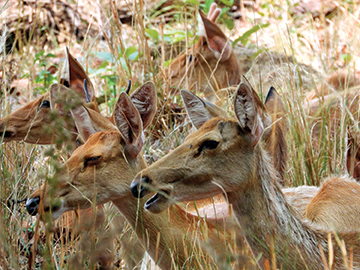
Entering Kanha National Park in the morning is magical not just because of the lush sal trees but because of its mascot (yes, called Bhoorsingh the Barasingha), the swamp deer. The morning light gives a magical golden hue to the swamp deer, making for a sighting that is completely mesmerizing.
The Species
The hard ground barasingha (Rucervus duvaucelii branderi) is one of three subspecies of swamp deer surviving in India and Nepal, and it occupies a genuinely unusual ecological position among them. The northern barasingha of the Terai, found in Dudhwa, Jhilmil Jheel, and in Nepal’s Shukla Phanta, lives in wet, marshy grasslands, and its ecology reflects that: soft ground, standing water, and seasonally flooded habitats. The eastern barasingha of Kaziranga and Manas similarly depends on floodplain grasslands and riverine habitats. The hard ground barasingha, by contrast, evolved in the dry, open grasslands of Central India, landscapes with a pronounced dry season, shallow soils, and hard ground conditions that would challenge any obligate grazer.
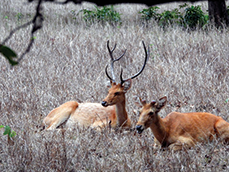
What makes this adaptation remarkable is that it is incomplete in the most ecologically interesting way. “Despite generations of living in a hard-ground landscape, the Kanha barasingha retains a strong ancestral affinity for wetlands and aquatic forage. Field observations at Kanha document animals readily wading into waterbodies to graze on aquatic plants: Hydrilla verticillata, Ceratophyllum demersum, Vallisneria spiralis alongside their primary diet of terrestrial grasses like Saccharum spontaneum, Themeda triandra, and Bothriochloa odorata. The species is classified as an intermediate, selective graminivore; more than 75% of its diet is grass across seasons, but it comfortably adds aquatic and semi-aquatic forage when available. This behavioural flexibility, sitting alongside a narrow dietary niche, is part of what makes the subspecies ecologically distinctive,” says Dr. Neha Awasthi, Independent researcher and ex alumni, Wildlife Institute of India.
Past Woes
However, the presence of the swamp deer was not like today. In the 20th century, a very significant change was observed in the distribution trend of Barasingha in central India. Gradually their number started decreasing as tribals started using the land for agriculture in the valleys of the Narmada, Mahanadi, Godavari, and tributary rivers. Added to this were hunters and biological pressure that made the species disperse. In 1938 when their population was assessed in the national park the numbers kept decreasing continuously and by 1970, only 66 Barasinghas were left in Kanha. “An enclosure was built by the forest officials of Kanha in 1970, which was free from predators. As it was very small, in 2007 this enclosure was expanded to cover 50 hectares. Kanha was declared a tiger reserve in the year 1973, due to which special attention was paid to the conservation of tigers and Barasingha deer. The relocation of villages started from the core area of Kanha. And the displaced villages were converted into large grasslands, and grasslands and ponds were constructed for their food and breeding,” says Ghanshyam Bhanware, Naturalist, Tathastu Kanha.
Making It Work
To save this endangered deer species, efforts were made to reintroduce it to Bandhavgarh Tiger Reserve and Supkhar Range (Kanha); efforts made between 1981 and 1990 failed. In 2015 the forest department relocated the Barasingha to Van Vihar National Park with full preparation, which was successful. “This time the forest department used an African technique called Boma, and a non-invasive capture method was used. After the success in Van Vihar National Park the forest department transferred some Barasingha to Satpura Tiger Reserve in 2015 itself which was a Boma and non-invasive capture method. Thereafter the forest department also transferred Barasingha to again Satpura Tiger Reserve and Bandhavgarh Tiger Reserve using the same method,” says Bhanware.
In fact, the measures that were taken at that time included the relocation of villages for wildlife something that was unheard of at that time and making predator proof enclosures. Durgesh Singh, co-founder of Outpost 12 by Sinali Experiences Pvt Ltd., says. “A proper habitat was created in the park where Barasinghas could have their choice of grasses, as they are very specialized eaters. They have a few species of grasses that they prefer to eat, and they are strictly grassland species that don’t venture into the forest.” Grassland management has been a central strategy in this conservation. “That also meant that big trees were not allowed to come up in the area so that the grasslands were never hampered in terms of growth and proper meadows could be developed. Likewise, de-weeding is a process where you take out the unwanted plants, not native or invasive in the area and that helps the native grass to grow,” adds Singh.
Expanding the Footprint
For nearly 50 years, every hard ground barasingha alive on earth existed within the boundaries of a single protected area. Kanha is exceptionally well-managed, but the conservation logic of having an entire subspecies concentrated in one geographic location, however good the protection, is deeply uncomfortable. “A single disease outbreak, a severe drought coinciding with a population low, an uncontrolled wildfire in a dry year, or an epidemic originating from the livestock populations in the surrounding buffer—any of these could devastate a geographically isolated population before managers have time to mount a response. Historical records from Kanha itself document serious rinderpest outbreaks in 1925–26 and again in 1976 that killed large numbers of gaur, sambar, and chital. The barasingha, confined to small habitat pockets at the time, escaped by chance. Chance is not a conservation strategy,” says Awasthi.
Earlier attempts to establish an alternate population were unsuccessful. In 1982, twelve barasinghas were captured at Kanha using chemical immobilization and transported to Bandhavgarh Tiger Reserve—all twelve died during the long-distance transport. Three further attempts between 1981 and 1990 to translocate animals within the Kanha landscape to Supkhar met with only partial success. “These failures were instructive. They shaped the design of what eventually became the Satpura programme – passive boma capture instead of chemical darting, shorter transport distances, customised vehicles, phased releases, and a predator-proof acclimatisation enclosure at the receiving site,” says Awasthi.
The Satpura reintroduction directly addresses the single-population vulnerability. With a breeding population now established across three grassland sites in Satpura and growing from 98 translocated individuals to 172 by 2023, the subspecies is no longer dependent on one location. Satpura sits around 350 km from Kanha, well within the historical range of the subspecies. Forsyth (1889) and Brander (1923) both documented hard ground barasingha in the Pachmarhi region, making it an ecologically and historically appropriate receptor site.
In Conclusion
At the end, what makes Kanha’s barasingha story special is that it actually represents the global conservation literature. A subspecies that fell to 66 individuals in 1970 and now numbers over a thousand free-ranging animals in Kanha, with an additional breeding population established in Satpura, is a remarkable outcome. It is often cited as one of India’s great conservation successes, and rightly so. “But it is important to understand that this recovery was not spontaneous. It was the product of fifty years of sustained, species-specific management: stringent protection, strategic grassland management, village relocation, controlled burning, water development, predator-prey dynamics management, and now active metapopulation establishment. The barasingha did not recover because Kanha became a good tiger reserve. It became good because the intensive management required to save the barasingha also restored the grassland ecosystem that the entire ungulate community, and through them, the tiger, depends on,” concludes Awasthi.
Bindu Gopal Rao is a freelance writer and photographer from Bengaluu. She enjoys birdwatching and environment, as well as taking the offbeat path when traveling. You can follow her on Instagram @bindugopalrao and find her work on bindugopalrao.com