The Dangers of the Exotic Pet Trade: From Tigers to Turtles by Emily Kennedy

By: Emily Kennedy

The introduction of the Internet and advancements in international shipping has brought the world closer together as well as elevated consumers’ interests in the exotic aspects of different countries.  The majority of such interests are positive in that people are learning more about other cultures than their own and many countries have benefited financially from international trade and tourism.  Some consumer interests cause more harm than good, however, one such interest is the exotic pet trade.

The exotic pet trade is the trade of live animals that have not been domesticated and are typically native to developing countries.  People not interested in having the simple dog or cat, which have been domesticated for thousands of years, increasingly have expanded their idea of a pet to include more novel animals such as non-human primates, parrots, reptiles, and even big cats.  The inclusion of exotic pets into the home can have devastating effects that not only affect the animals, but the owners and environment as well.

Many of the animals in the exotic pet trade are taken out of environmentally sensitive areas such as the rainforest.  The capture and sale of animals from the wild often includes killing the mother in order to take the young, further increasing the extinction rate of many already endangered animals.  Some birds and reptiles, in addition, have a calculated mortality rate that can reach sixty to seventy percent, and even eighty to ninety percent for reef fish.  The loss of animals from the wild is a dangerous outcome since ecosystems rely largely on animal carriers to spread plant seeds through their fur and dung.  Animal prey and predators furthermore rely on each other so as not to starve from either loss of prey or overpopulation due to lack of natural predators. 

Supporters of the exotic pet trade are quick to point out that the majority of animals involved in the trade are in fact bred in captivity and, therefore, do not affect the wild.  The problem is that these captive bred animals are still called exotic because “they have not been intensively and selectively bred for life with humans,” says Mark Derr, author of many social and environmental books as well as articles for the New York Times, Audubon, Atlantic Monthly, and Natural History.  This “wildness” and rarity of the exotics are in fact what entice buyers.  The outcome is that animals that have not been “wired” for over thousands of years to live with humans are now living with humans. 

A baby tiger or monkey may be a very cute and lovable pet, but once it grows older and stronger the safety of the owner is at risk.  Some solutions for controlling older animals have been to de-claw or de-tooth them.  This method is a demoralizing practice that takes away the very parts of an animal that often defines it.  How does a bird feel if it cannot fly?  Even if an animal does keep all of its body parts, the minimal space it has as compared to the wild often creates insane, depressive, and violent behaviors.  Such mental problems can be often seen in self-mutilation such as tearing fur or feathers off their limbs (refer to pictures of Denise the Gibbon).

Denise, a poor victim of the 
exotic pet trade

The safety of the public is not only an issue for people with dangerous animals such as big cats and non-human primates, the risk of contracting diseases between human and animal is a much larger threat.  The spread of monkey-pox from infected prairie dogs in 2003 and the ever-present risk of reptile-associated salmonellosis are just two examples of how seemingly “safe” exotics can be dangerous.  In the case of Salmonella, risks to children rise as the popularity of baby turtles, lizards, and snakes grow.  Ninety percent of reptiles are asymptomatic carriers of Salmonella bacteria says Michelle Jacmenovic, a research associate of the Humane Society’s Wildlife Advocacy Division.   Simon Hable, Director of the North American branch of Traffic, an international organization that monitors the trade in plants and animals, has said that pet reptiles account for 2.5 million imports a year.

(Left) Denise when she first arrived to the Highland Farms Gibbon Sanctuary in Mae Sot, Thailand.  She had formerly been a pet. If not for her arms, you would think she was a Capuchin monkey.  Photo by Pharanee Deters. 
For photos of what gibbons should look like, go to www.ippl.org  or hasekamp.com

The source of these problems is due not only to illegal trades but, also, due to the unclear and loophole-ridden regulations of the exotic pet trade.  “It’s kind of an old-fashioned industry where we take people at their word,” says Mike Hoffer, owner of Hoffer’s Tropic Life Pets (which sold infected prairie dogs), of the trade.  The pet trade is full of infected, illegal, and mistreated animals largely due to loosely enforced and scattered regulations.  “The U.S. government doesn’t prohibit the ownership and sale of exotic animals, however, some counties and cities do,” says Susanne Quick of the Milwaukee Journal Sentinel.  It is relatively easy to illegally transport an exotic from one part of the country to another because laws are often unknown and misunderstood due to inconsistent regulations and lack of enforcement.

The ideal solution to the mounting negative aspects of the exotic pet trade would be to ban it nationally, even internationally if possible.  At a minimum, laws concerning the health and sale of exotics need to be made uniform and enforcement strengthened.  As far as international regulations are concerned, the Convention on International Trade in Endangered Species of Wild Fauna and Flora (CITES) will meet this November to discuss increasing or decreasing CITES protection for 54 species of wild fauna and flora.  If our laws are not changed dramatically, the health and safety of the environment, wildlife, and the public are at a great risk. 

For more information and an update, please visit the CITES (www.cites.org) and Traffic (www.traffic.org) websites.


Emily says what you can do:

  • Do not buy exotic animals
  • If you know people who are planning to buy an exotic animal, inform them of the trade and its negative aspects.
  • f you know of exotic animals being sold illegally, inform the authorities and follow-up.


Emily Kennedy recently graduated from Eckerd College with a BA in Anthropology and a minor in Environmental Studies.  She has volunteered at the Highland Farms and Wildlife Refuge in Mae Sot, Thailand and with the Primate Dept. at the Lowry Park Zoo in Tampa, FL.  For the past year she worked as a research assistant for a six-year, White-faced Capuchin Monkey project in Bagaces, Costa Rica.  Currently she is interning at the Jane Goodall Institute.


On November 3rd, 2004, Governor Pataki signed into law a measure that will ban the keeping of certain exotic animals as pets in New York State. S7616 which will make it illegal to keep primates, large cats and many dangerous snakes as pets in New York. Those owning prohibited animals on January 1st, when the new law takes effect, will be permitted to keep them provided that they can comply with stringent animal care and public safety requirements.


The chapter amendment to the law makes technical changes in addition to expressly permitting ownership of New World monkeys trained to assist people who are paralyzed from the neck down. Such ownership will be predicated on securing a permit from the state.

Empathy with other Species is the Key to Ethical Wildlife Photography by Jim Robertson

By Jim Robertson

A deep admiration for nature has led many to another level of appreciation--the craft of wildlife photography. Unfortunately, not all who photograph wildlife do so out of caring and with respect for our fellow beings. In fact, the behavior of many photographers, both amateur and professional, can only be described as disrespectful, disruptive and sometimes dangerous to the animals they are photographing.

For example, every spring in Yellowstone you are sure to see a large group of photographers standing around--or even sitting on lawn chairs--talking loudly right outside some poor badger’s birthing den, waiting for the family to emerge. Though these folks may think nothing of the clamor of a rowdy bar or ball game, how would they like to live next door to that bar or ball field, or wake up to the racket of an expectant crowd of photojournalists right outside their bedroom window?

In response to this kind of ill-behavior, which invariably results in the harassment or endangerment of wildlife, informal guidelines have been established to spell out just how close, in yards or feet, one should get to an individual animal, depending on that species’ tolerance zone.

But rather than memorizing numbers and gauging distances, perhaps it would be easier for photographers and wildlife observers to apply the golden rule in each and every situation. However, instead of the old, oversimplified rule, “Do unto others as you would have them do unto you,” why not adopt a revised golden rule that takes into account the differences between ourselves and other species? Maybe something like, “Do unto others as you think they would have you do unto them.” In other words, try to envision what the animals’ needs and self interests are and take into consideration how their lives in the wild are different from our own. Empathy, the intellectual or emotional identification with another -- or the ability to relate to others -- is essential for maintaining ethical standards when photographing wildlife.

Badger Den

This mother and young badger were photographed across the road from their den using a 600mm telephoto lens and a 2X multiplier.

Last spring I watched from a distance as the annual gathering of noisy photographers was posted outside the entrance of a badger den. They were so deep in conversation and oblivious to their surroundings that none of them noticed as the mother badger finally made a break for it in hopes of procuring food for her young. The day before, I had photographed the same badger den from across a road with a 600mm telephoto lens fitted with a 2X extender to bring the subject in closer without actually getting close. Because I remained on the opposite side of the road and well away from the den, quietly giving them the space they needed to engage in their activities and enjoy the sunny day, the badger and her young came and went freely, without paying me any notice.

A national Park like Yellowstone can be the perfect place for photographing animals without causing them undue stress. Since they know they are safe from hunting within park boundaries, “game species” are not so distrustful of human presence. Although many species are easily viewable from park roadways, they are much less concerned about vehicles than people approaching on foot. Staying in your car makes wildlife feel more comfortable, and your vehicle makes a great blind for photographing animals calmly going about their business. Some of my best photos have been taken out of the window of my rig.

Other examples of photographer misconduct include trimming away vegetation--that may conceal a nest or den from people and predators--to get a clearer photo, throwing food to attract animals, and the all-too-common habit of yelling or honking at an elk, a bison or a family of bears so they will look toward the camera. By using empathy we can begin to recognize changes in behavior and respect the signals animals use to convey to us that we are irritating them or getting too close for their comfort. Every year irresponsible photographers are gored by bison, trampled by moose, or charged by bears. When these animals are annoyed to the point that they feel the need to defend themselves, chances are they will suffer or die for it in the end. Thoughtless conduct can also force animals to leave their familiar surroundings, interrupt natural activities necessary for survival, or even separate mothers from their young.

Outdoor Photographer magazine ran an article in January/February 2000 on “Tips for Photographing Eagles” with the sub-heading “A long lens, the right location and a sensitive approach can get you excellent images of these majestic birds”. The author of the article, Bill Silliker, Jr. wrote, “If you don’t have a long lens, don’t push it. Ethical wildlife photography requires that we forego attempts to photograph wildlife when we’re not equipped for it or if the attempt might harass or somehow place the subject in jeopardy. Be satisfied with images that show an eagle in its habitat. Editors use those too.”

The other day a neighbor stopped by and, upon seeing the small herd of black-tailed deer who found refuge on my land, asked if I was a hunter. When I said, “No, I’m a wildlife photographer,” he shrugged and replied, “It’s all shooting.”

Well, yes and no. The obvious, major difference is that the animals “shot” with a camera do not end up dead. But because there are similarities to hunting, many people approach wildlife photography with a similar mind-set. It’s laughable to see photographers in a national park camouflaged from head-to-toe, sometimes including face paint, photographing a bull elk as he calmly grazes alongside the road--fully aware of their presence. And I couldn’t count how many times I’ve seen tourists run right up to a bear, elk, bison, or moose with a tiny disposable camera to get their close-up “trophy” photo. They seem to think it’s only fair--that they are entitled to get closer--since they don’t have a large telephoto for their camera. But if they were to examine their motives they would realize that their behavior is not fair to the animal. Is their trophy more important than the well-being of the subject of their photo?

Bull Elk
This bull elk was photographed from my vehicle in Jasper National Park, Alberta, using a telephoto lens

Grizzly Bear

This sow grizzly bear was photographed with a 600mm telephoto from a supervised Forest Service observation platform along Fish Creek, in Southeast Alaska.

Most photographers and photo editors do not differentiate between wild or captive animals when selling and publishing images. Using photos shot at game farms supports those who profit from exploiting animals by keeping them captive to serve as models for photographers, entertainment for tourists, or targets for trophy hunters. At the same time, these photos set a new, unnatural standard for closeness and intimacy with animals that the public expects to see in every future image.

And while on the subject of ethics, how ethical is it to top off a day of photographing waterfowl or ungulates with a dinner of poultry or red meat? Don’t all living beings deserve our compassion and respect? I had long heard that animals feel less threatened by someone who does not eat meat, but I wondered how long a human could survive without consuming the flesh of others. After six years as a vegan, I can attest to the fact that wild animals are not as fearful of me now, and that saying “no” to animal protein is healthier and easier than I ever would have imagined.

-- Jim Robertson

Mohonk Preserve Members Should Say “No” To Controlled Burns by Ron Baker

By Ron Baker

      At a meeting at the Mohonk Preserve, it was stated that there was some concern about wildfires if there should be an extremely dry summer, and that these fires could be exacerbated by some of the blowdowns caused by wind and ice. The touted cure was “controlled burning.”

      The truth is that “controlled burning”, like wildfires, can be very destructive.  Even low-level ground fires can kill insects, toads, salamanders, mice and voles who are in burrows close to the surface.  Low-growing bushes that can provide food for many species of birds and mammals are often killed.  Since much burning is done in the spring, the smoke-producing fire can drive away nesting birds.  Those that return will find a dramatically altered environment and a diminished food supply.  Moreover, a charred ground surface is far from an ideal habitat for any animal.  Even burning fields in late autumn (as is presently being considered at the Preserve) destroys the seeds of frost-killed tall grasses and late blooming flowers.  These would otherwise be eaten by some species of wintering birds.

      Regular burning results in the depletion of soil quality by destroying microorganisms essential for healthy plant growth.  The result is inferior, low-grade plant life, as is found in Albany’s (NY) Pine Bush.  Since plant eating animals are only as healthy as their food supply, this principle applies all the way up the food chain. 

      Moreover, it isn’t uncommon for “controlled burns” to become uncontrollable.  There have been many news stores about these.

An Excerpt from the Reno News in 2000:

“The National Park Service’s controlled burn near Los Alamos N.M., is the most deadly example… So far it has scoured some 50,000 acres, historic structures at the old atomic-bomb site, hundreds of homes and tribal land. At last count, 405 families had been burned out. Businesses suffered too, being cut off from customers.”

       Several years ago a “prescribed burn” in the Pine Bush raged out of control after a sudden strong wind sprang up.  A specially assembled fire-fighting crew and a DEC helicopter were needed to extinguish the blaze.

       Since “fire management” is an environmentally destructive practice, one would be justified in asking how it became fairly widespread.  As you probably know, it was first proposed some 70 years ago by Aldo Leopold, who was much less of an ecologist than the historical revisionists have led many people to believe.  Today, many of Leopold’s contentions are anachronisms.  Nevertheless, they are still quite widely accepted by forest and wildlife managers.

      The use of fire to manage wildlands didn’t come into general use until the mid-1970s.  Prior to that time, a policy of complete fire suppression was usually pursued.  The period between 1973 and 1978 was a time of severe economic recession. In New York State unemployment bottomed out at 11.3 per cent, the highest state unemployment rate since The Great Depression.  The federal and state governments sought ways to balance budgets by saving money. Forest and park rangers and fire wardens were laid off.  The belt-tightening increased during the Reagan presidency.

      Since fire-fighting funds were cut, it became common policy to allow fires to burn themselves out on wildlands where homes were not threatened.  Likewise, some forestlands were burned, ostensibly to prevent serious fires later.  This was like throwing the baby out with the bath water, but it was good dollar diplomacy.

Forest and park officials now began to claim with increasing certitude that was the use of fire was an ecologically sound practice.  (Naturally, when people engage in an activity, for whatever reason, they will usually try to justify it.)

      The myth that fire is environmentally beneficial became incorporated into ecology textbooks used in colleges and universities, and is advocated by many professors whose programs are funded in part by groups such as the American Forestry Association.  The primary problem with these programs is that no emphasis is placed upon an empathy with life and a reverence for Nature.  But this is consistent with most forest and wildlife management practices, which are designed to produce sometimes-illusionary short-term benefits, usually at the cost of long-term hazards for the rest of Nature.  That is a problem inherent in most commercial enterprises.  There are responsible ways to manage natural lands, but they are benevolent and constructive, not malevolent and destructive.

      The most basic problem is the prevailing cultural view that human beings are superior to the rest of Nature.  Therefore, according to this philosophy, people have an inherent right to use, abuse, or manipulate it in any way that suits their interests.  Otherwise good people can often be influenced by bad ideas, especially if these are presented in a seemingly logical fashion and if there would appear to be some benefits that result.

      It’s true that some ecosystems, such as pine barrens<, have arrived at their present state as a result of periodic fires.  The question is why these fires occurred.  In the vast majority of cases they were a result of carelessness, or were caused by deliberate fire setting by mentally disturbed people.  This was true for many years in central New Jersey and in the Pine Bush.  Simply because fires have burned over an area on a regular basis doesn’t mean that fire is beneficial to the natural world!If these lands were to remain undisturbed by human acts and destructive natural forces they would evolve toward a climax state.  Some forms of life would slowly disappear but many others would move in to take their place.  Many pine barrens have become so scarred by fires that they are essentially sick ecosystems that support limited numbers of plans and animals.

      Today, some forest and wildlife managers seem to be in competition with careless campers, irresponsible hunters, and deliberate match throwers.“Fire management” is a principle that, in many parts of the United States, has become increasingly irresponsible over the years.In parts of the West and Southwest napalm and chemicals are used to start major fires, even crown fires, to destroy insect infestations or for other land or wildlife management purposes. 

      The use of fire to mange woodlands and open spaces is short-sighted, unscientific, morally questionable, and can be very destructive to plant and animal life.It is my opinion, based on much experience elsewhere, that if fire is allowed to be used in Mohonk Preserve, it will be employed with increasing frequency and in increasingly irresponsible ways as time goes on.Invariably, Nature will be immeasurably diminished.

       The problem at Mohonk Preserve, and on natural lands elsewhere in this region, is not droughts and blowdowns.The problem is with people who are careless with fire, since lightning-set fires are extremely rare in this part of the country.The time, money, and effort should be directed toward public education which might help to foster true ecological awareness.

      I would like to voice my strong opposition to the seriously misguided plan for burning on Mohonk Preserve.


Ron Baker is a naturalist who homesteaded in the Adirondacks for 27 years.The only way to his handbuilthomestead was to cross a beaver pond and hike for 40 minutes uphill through a rugged forest.Mr. Baker was editor of the Backwoods Journal, a publication through which homesteaders shared the knowledge they’d accumulated over the years living in the woods.It was read by homesteaders, and aspiring homesteaders or those who could only homestead vicariously.  In 1985, Mr. Baker published The American Hunting Myth.  The book was a well-documented condemnation of wildlife management for hunting.  After moving to the Hudson Valley a few years ago, Mr. Baker joined the Mohonk Preserve in order to hike and explore the beautiful preserve area.

Into The Woods Mentoring Youth in the “Invisible Classroom”

By Jeff Davis

Twelve-year-old Melody Kauff’s outdoor education comes in three ways: from the mice whose tracks she follows, from the girl who in a game called “Follow the Scout” led her inadvertently to discover an owl pellet with a skull and teeth mixed in, and from the man in his forties she calls her mentor.

Like numerous youth in the Mid-Hudson Valley, Melody receives an education most of us adults would envy—an education in how to live confidently among deer and bear, owls and hawks.  Programs, informal groups, and home schooling opportunities in the area are helping to raise a generation that doesn’t simply believe in its integral connection to the earth’s myriad inhabitants. They live it.

Mentoring programs intimately connect youth to larger communities — human, animal, and plant—through teaching them how to live in nature. At my first workshop on building a mentoring community recently, my hands joined with some forty people, ranging from a spry six year-old to a grizzly sixty-five year- old, who held hands and closed the circle.

While we stood in the meadow, workshop leader Mark Morey told the youth that for the next two hours they must go out into the woods and return with certain “goods”: evidence of specific types of owl, evidence of fox, dogbane for cordage, and more. “You’re going to need each other,” Morey told them. “So, first plan how you’re going to stay together, and how you’re going to find what you need.”

Morey’s purpose, as I would discover, was not simply to send the kids off on a natural treasure hunt. These tasks were part of a larger vision to help youth become more oriented to nature and more empathetic with wildlife.

The youth later returned not just with the required “items” and evidence. After going through an extensive questioning session with Morey, cofounder of the Vermont Wilderness School, they also possessed a deeper appreciation for their natural community. One boy told me he never really understood an owl’s diet and hunger until he felt with his own hands one of its pellets. A young woman said this experience had deepened her appreciation for preserving wildlife’s habitats. Consequently, she’s become involved with a local animal rescue organization.

These mentoring communities emphasize our responsibility to one another and to wildlife. And it begins, according to Morey, with authentic human commu- Into the Woods: Mentoring Youth in the “Invisible School” nities connected intimately to natural communities. Adult mentors, Morey said during a telephone interview, “raise the bar of expectation for youth in terms of character.” Children consequently grow up more aware of their responsibility both to the human community and the natural community. Morey recently sent an older student, for example, to the Canadian border to assist in a project to track and possibly help preserve lynx, now endangered.

Empathy with Wildlife

Morey’s zeal for building mentoring communities inspired Charles Purvis of Accord, New York, four years ago. After participating in programs similar to Morey’s, Purvis said he instantly saw in his two sons an “amazing awakening marked by wonder, enthusiasm, passion.” Last autumn, Purvis, David Brownstein of New Paltz, New York, Chris Victor, and others formed Red Fox Friends, a group that offers youth workshops and summer camps to further this community-building.

Imagine the world as an animal. How does he see? How does he smell? How does he hear? These are typical activities that Purvis and others at Red Fox Friends engage youth in.

In an activity called “Owl Eyes,” boys and girls learn to view the birch and cedar in front of them with a soft focus. Then, they learn to heed their peripheral vision and “un-focus.” Doing so, Purvis notes, gets youth out of their rational, thinking mind and into a more wondrous state of mind that helps them empathize with animals. With the “Deer Ears” activity, youth try to hear everything they possibly can—what’s above, behind them, beneath them. They try to heed the tiniest ant crawling on a dead leaf. Doing so helps them recognize, too, that someone furry probably is listening to their every move.

And when the kids practice “Fox Walking,” they learn how to walk as silently and “invisibly” as possible like a fox. In some instances, Purvis says, some kids have been able literally to walk right up to a deer. Other wilderness programs in the area offer young people similar opportunities. Riccardo Sierra, Director of Hawk Circle Wilderness Programs—an hour southwest of Albany—says that building bonds between adults and youth is more important than imparting skills. These workshops and summer camps are not about just “cramming” information, says Sierra who has taught in New York since 1989. “The real learning happens between the skills” of animal tracking, fire building, and edible plant harvesting. The nearby Mohonk Preserve’s array of dynamic summer camp programs also heightens youths’ awareness of the outdoors in the context of building human relationships.

To introduce youth to the wilderness, naturalist and environmental educator Jay Leavitt founded the non-profit organization The Red Tail Rising School for Natural History. Leavitt and his groups of home-schooled youth, among other activities, take regular outings to the Adirondacks to track pine marten or cougar. These youth, Leavitt says, amaze him not just from their knowledge of animal behavior but also from their conviction to make the world better for their winged and furry friends.

The heart of these experiences is not about findings as if on a wild treasure hunt. For Bosch Purvis, who turns thirteen in March, it’s about becoming comfortable in nature. “I don’t mean just taking a walk in nature,” Bosch says. “I mean, you know, being comfortable in nature for three weeks without staying in a building.” An avid skier, sledder, and soccer player, Bosch is learning to love the outdoors for more than recreation. He and Melody and thousands of other lucky youth are discovering core parts of themselves as well in what some people like to call “the invisible school” — wilderness.

Jeff Davis is author of The Journey from the Center to the Page (Penguin 2004), His articles appear in publications such as Conscious Choice and Enlightened Practice. He is managing editor of Wildlife Watch Binocular.

Proposed Global Warming Solution: More Harmful Than Helpful to Wildlife

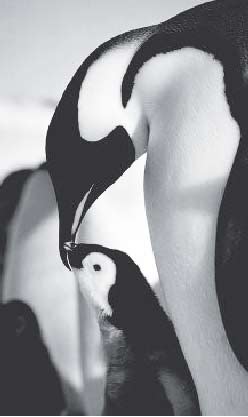
Luc Jacquet’s documentary film March of the Penguins — due out this July — follows emperor penguins’ travails as they struggle

penguins
Baby penguin reaches for food
Photo by Guillaume Dargaud

to mate and to raise a family in the harsh Antarctic. Faced with winds reaching some 90 MPH, the females march over 70 miles and back to find food. Yet, nature’s sheer forces aren’t penguins’ only challenge. Mounting evidence suggests that global warming — as well as a proposed solution to confront global warming — will bring even more peril to penguins and other species across the planet.

The phenomenon of the greenhouse effect is fairly straightforward. As solar rays heat Earth’s surface, part of the energy forms into infra- red radiation. Much of that is absorbed by molecules of CO2 and water vapor in the atmosphere and reflected back to the surface as heat. The gaseous molecules thus act like a greenhouse’s glass panes by retaining the sun’s warmth. Too much heat retention can make Earth another Venus, steaming and unlivable for virtually all animal species