

Captive breeding-led crocodile conservation has boosted the population of estuarine crocodiles that was on the brink of extinction during the 1970s to a healthy 1858 today.
by Bindu Gopal Roa
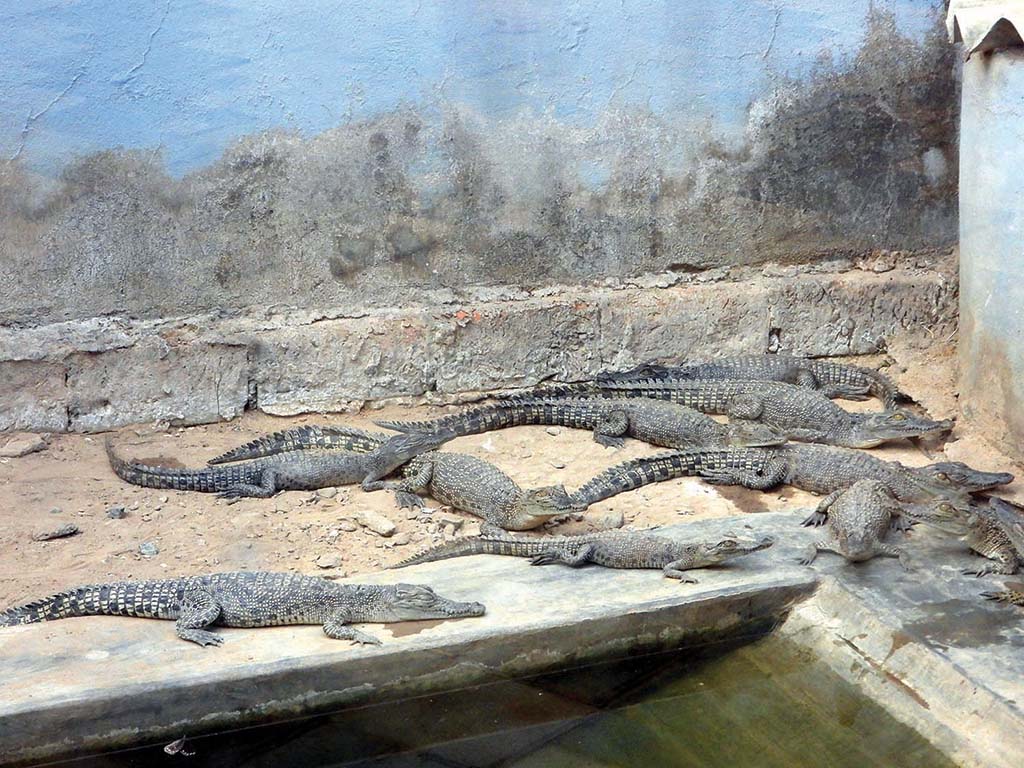
The Crocodile Hatchery & Rearing Programme in Odisha’s Dangamal is a testament to the revival of saltwater crocodiles in the Indian subcontinent.
Revival cues
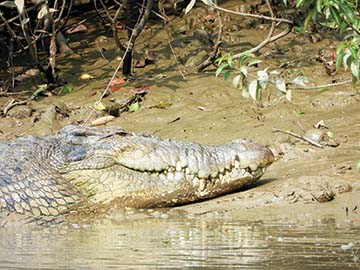
Living amidst an intricate network of creeks, channels, tidal rivers, and dense mangroves, saltwater crocodiles are a huge draw in the Bhitarkanika National Park today. In fact, the density of the crocodiles here has meant that local tourism is booming. I recently experienced this firsthand when I got on board the Antara River Cruises’ plush catamaran.
As Antara is the only player that has permission to dock overnight on the Brahmani, Baitarani, Dhamra, and Patasala rivers, I had the rare opportunity to see these crocodiles up close myself.
This species has been placed in Schedule 1 of the Wildlife (Protection) Act, 1972, and in Appendix 1 of CITES (Convention on International Trade in Endangered Species of wild fauna and flora). In India, presently the saltwater crocodiles are limited to Sundarbans, Bhitarkanika, and the Andaman Islands.
During the 1950s and 1960s, illegal hunting of crocodiles was at its peak, and the species was on the verge of extinction. To conserve the saltwater crocodiles along with supporting rich biodiversity and to strengthen management practices, Bhitarkanika was declared a wildlife sanctuary in April 1975. The Saltwater Crocodile Research and Conservation Project was established at Dangmal under the technical guidance of Dr. H.R. Bustard, FAO/UNDP. Chief Technical Advisor to the Government of India. The prime objective of the program was the ‘rear and release’ of crocodiles to build up the depleted population in the wild.
This is when, for the first time, a clutch of 48 eggs was collected from the Kalibhanjdian island, surrounded by the Dhamara River, in July 1975. Of these, 24 hatchlings, including one white hatchling (locally known as ‘Sankhua’), hatched in the third week of Aug. 1975. At that time, the number of saltwater crocodiles in the river systems of Bhitarkanika Wildlife Sanctuary was estimated by researcher Dr. Sudhakar Kar to be only 96, including 35 adults as per the 1976-1977 winter census. The first release operation was carried out in Dangmal Creek in April 1977 with a batch of 15 juvenile crocodiles of above 1 m length. The depleted population of estuarine crocodiles in the river systems in and around National Park has been built up gradually. Since 1990, mass egg collection for hatchery incubation and release of young ones has been discontinued. And as per the last census, done via drone, the number stands at a staggering 1858.
Hatchery and rearing complex
To understand this better, I visited the hatchery and rearing center at the Kanika Wildlife Range in Dangmal. Here the entire lifecycle of the captive breeding is seen in clear steps. Firstly, after diverting the attention of mother crocodile guarding the nests, eggs are collected very carefully in a container by the nest survey team. The exact orientation of the eggs, as was observed in the natural nest, is followed while keeping the eggs in the container.
Artificial nests are prepared after processing leaves of Hental (Phoenix paludosa), Kharkhari (Acrostichum aureum), Nalia (Myriostachya wightiana), etc. The nests are externally applied with mud for regulating the temperature and moisture of the nests. The hatchlings hatched out of the artificial nests are allowed to remain for a week on the sandy bed duly disinfected by potassium permanganate solution for post-birth care and development. The hatchlings are then released into the pools filled with natural brackish water. The hatchlings are fed on small live fish and prawns for better growth.
The incubation period of the eggs varies from 75 to 80 days. Lower incubation temperatures (28°C-32°C) produce mostly females, and higher temperatures (33°C-34°C) produce males. Depending on the size and age of the females, the number of eggs laid in each nest varies from 10 to 70 eggs. The eggs are porcelain-white and hard-shelled, and the average weight is 120 gm (range: 100-140 gm). Only one clutch of eggs is laid annually,” explains my guide Sanghamitra from Antara Cruises. Prehatching vocalization (crocking sound) is produced by the emerging hatchlings as a call to the mother.
After the emergence of hatchlings from the nest, their congregation is seen in the wallows surrounding the nests, in groups called ‘creches.’ Mothers actively guard the newborn hatchlings to save them from predators. In the initial period, hatchlings show gregarious feeding behavior. Males are generally larger and grow above 20 ft (6.1 m), but females can grow up to 12 ft (3.6 m). The maximum weight of an adult male is around 1000 kg, and that of an adult female is around 400 kg, and the snout of a male is U-shaped, whereas that of a female is V-shaped.
At the museum adjoining the hatchery complex I meet Ranjith Biswas, the caretaker, who explains that the largest crocodile here is a whopping 23 feet long. After looking at the various exhibits, including skeletons of these crocodiles, I watch a film that is a fitting ode to this conservation story. The last words I hear in this beautiful film are “There is no better place in the world for a crocodile to call its home than Bhitarkanika.” And as I head back to the cruise and see so many saltwater crocodiles on this cruise, I can’t help but agree.
Bindu Gopal Rao is a freelance writer and photographer from Bengaluu. She enjoys birdwatching and environment, as well as taking the offbeat path when traveling. You can follow her on Instagram @bindugopalrao and find her work on bindugopalrao.com