

How Rope and Rope Alone is Changing Wildlife Conservation in South Africa
by Samuel Peters
Somewhere above the Peruvian Amazon, in the quiet hours between dusk and midnight, a sloth grips a rope suspended between two trees. It moves in its characteristic slow-motion way, hand over deliberate hand, navigating a structure it had no evolutionary preparation for. A camera trap catches every frame. What it records is not just an animal crossing a gap; it is evidence of an idea that is rapidly remaking how scientists think about forest connectivity.
Artificial canopy bridges; systems of suspended ropes, nets, and platforms strung between treetops have existed as a conservation concept for decades. But a new wave of rigorous field research, now emerging from both the Amazon and Brazil’s Atlantic Forest, is turning scattered observations into hard science, and hard science into policy.
The Problem With Roads
For most wildlife, a road is an inconvenience. For a sloth, a monkey, or a porcupine, it can be a death sentence or something nearly as damaging: a permanent wall.
These animals are obligate canopy-dwellers. They eat, sleep, breed, and travel entirely above the forest floor. Many have no instinct for descending to the ground, and some lack the anatomy for it. When a highway cuts through their forest, they do not simply walk around the problem. They stop. They stay on their side of the road, increasingly isolated from other members of their species, cut off from food sources and potential mates.
The consequences compound with time. Roads isolate animal populations, affecting their genetic diversity and threatening their long-term persistence. A meta-analysis of mammalian species found that arboreal mammals are among those most negatively affected by fragmentation; a pattern that makes intuitive sense. For a flying squirrel or a gibbon, a road is a gap to cross. For a sloth, it may as well not exist as an option.
With the loss of canopy connectivity, animals either come down from the trees and try to cross roads, risking vehicle collisions, or stay at the canopy level and suffer from population isolation, a phenomenon researchers call “the barrier effect.” By some estimates, 475 million vertebrate animals are killed by vehicles every year in Brazil alone.
What the Cameras Are Showing
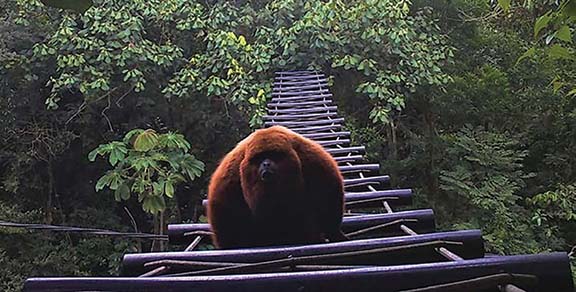
In late 2025, biologists Justin Santiago and Lindsey Swierk of Binghamton University published findings from a study conducted at the Amazon Conservatory for Tropical Studies in Peru, inside a protected reserve near the city of Iquitos. They set up four camera traps at varying heights along a walkway of ropes and wooden bridges spanning between 6 and 36 meters above the ground, and ran the cameras around the clock for three weeks.
The results were striking. The cameras caught a clear pattern: the forest wakes up when the sun goes down. From 7 p.m. to 10 p.m., mammals crossed the bridges again and again. Among the most consistent visitors were Linnaeus’s two-toed sloths, which remained active until as late as 4 a.m.
The study also documented porcupines and opossums on the bridges, and captured footage of the streaked dwarf porcupine; a species so rarely observed that scientists classify it as data-deficient.
The researchers were careful to note what the study does not yet prove. Understanding how animals behave on bridges in continuous, undisturbed forest is the necessary foundation before drawing conclusions about fragmented ones. But the data provides exactly the kind of behavioral baseline that future corridor design will need.
From Rope to Road Policy
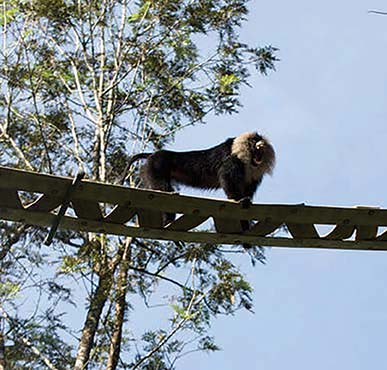
In Brazil, the stakes are more urgent and the scale larger. Brazil has the fourth-largest road network in the world, which continues to expand. Forty percent of primate species are endangered in Brazil, with habitat fragmentation and vehicle collisions among the main threats they face.
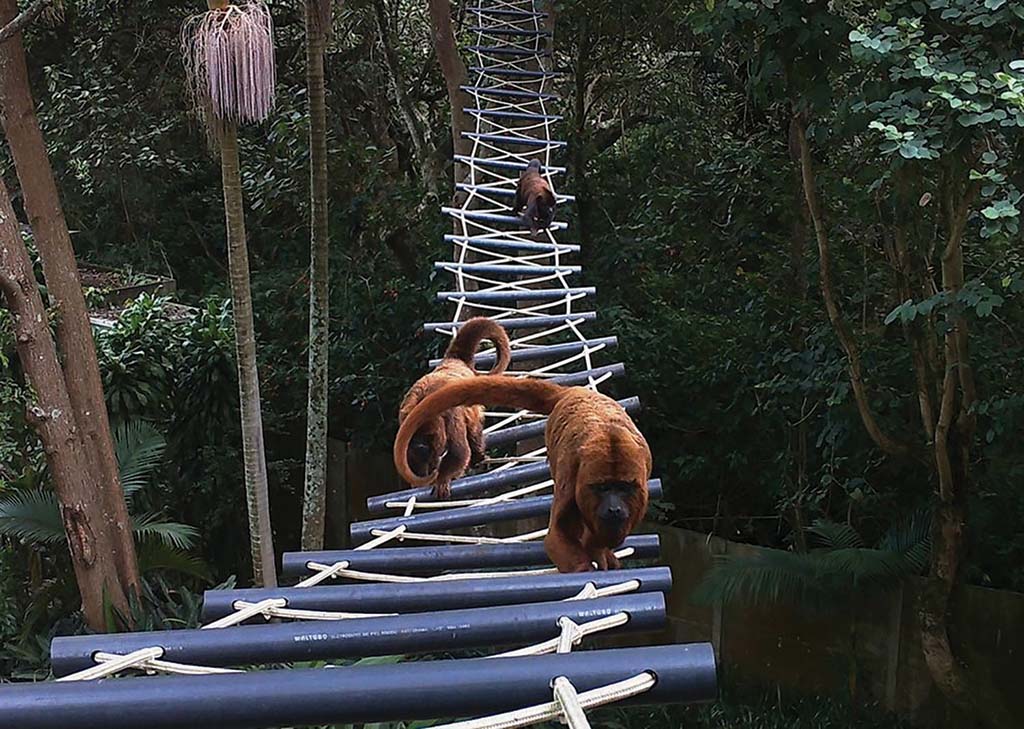
Biologist Fernanda Abra has spent years turning that crisis into a construction project. Her Reconecta Project, based on Highway BR-174; a 3,300-kilometer highway slicing through the Amazon has taken a deliberately practical approach. Each bridge costs around $200 in materials, versus tens of thousands to hundreds of thousands of dollars for a conventional overpass or underpass. The structures consist of steel cables, ropes, and nylon nets anchored to concrete posts, and come in two designs: a rope lattice and a single braided cable. Research has found that kinkajous prefer bridges with X-shaped crossed lines, while monkeys favor mesh netting between the rungs.
By early 2025, the project had constructed 39 bridges and recorded nearly 2,000 crossings by six different species, including black-capped capuchins, critically endangered Alta Floresta titi monkeys, and endangered Schneider’s marmosets.
Central to Reconecta’s success is a partnership that blurs the line between science and indigenous stewardship. The Waimiri-Atroari people have been collecting data on wildlife roadkill along a 125-kilometer stretch of BR-174 that cuts through their territory since 1997; the largest citizen science project involving an indigenous community on the planet. Their ecological knowledge shaped where the bridges were placed. More than 150 community members participated in their construction.
The Design Problem Nobody Talks About
One of the quieter insights emerging from this research is that a bridge designed for one species may be useless or even avoided by another. A two-parallel-rope design created for gibbons in Southeast Asia may not work for spider monkeys in the Amazon. Solutions for one species or habitat may not be applicable for another.
This is why the Peru study, conducted in continuous forest rather than fragmented habitat, carries particular value. By observing how animals interact with bridge structures in the absence of road-related stress, researchers can begin to understand species-specific preferences before imposing those structures in crisis zones.
What Comes Next
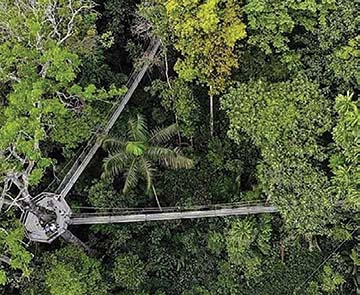
The momentum is real. Brazil’s national transport department has begun recommending standardized canopy bridge models for highway projects. Brazil’s infrastructure agency, DNIT, is planning to install almost 100 canopy bridges on the BR-319, the road connecting Porto Velho to Manaus. In Peru, WWF has been installing bridges over logging roads in the Madre de Dios region, where species like kinkajous and night monkeys have been documented using the structures.
The images from these projects are not dramatic. They do not require a predator or a crisis. They are simply animals, doing what animals do, in a corridor that humans built and then got out of the way of.
That, it turns out, may be the most important thing a conservationist can do.
Samuel Peters is an African ecologist and conservationist with the Wildlife Institute. He can be reached at samuelpete786@gmail.com